



The Great AI Convergence: Analyzing the Rise of GPT-5.5 and Claude 4.7 in the Era of Agentic Intelligence
The technological landscape of 2026 has been permanently altered by a week of unprecedented releases that have redefined the boundaries of artificial intelligence. With the official introduction of OpenAI’s GPT-5.5 and the subsequent rollout of Anthropic’s Claude 4.7, the industry has officially transitioned from the era of conversational chatbots to the age of autonomous agents. This shift represents more than just an incremental increase in processing power or token windows; it signifies a fundamental change in how machines interact with the physical and digital worlds. For the first time, these models are demonstrating a capacity for independent planning, tool utilization, and self-correction that closely mimics the workflow of a high-level human professional.
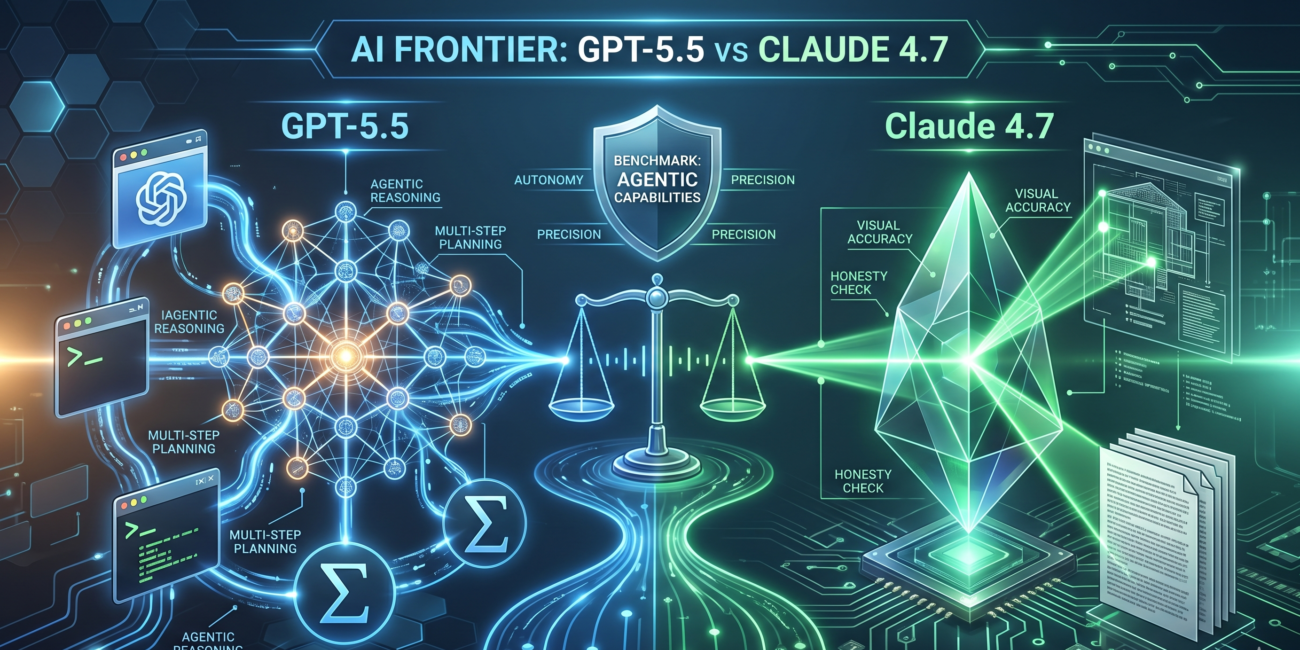
The arrival of GPT-5.5, internally codenamed “Spud” during its development, has been met with both awe and intense scrutiny. Unlike its predecessors, which primarily operated as sophisticated text predictors, GPT-5.5 is built on an agentic framework designed to navigate ambiguity. This means that when a user provides a complex, multi-layered objective, the model does not simply generate a response; it constructs a multi-step execution plan, accesses external browsers or software terminals, and iterates on its own work until the goal is achieved. This evolution has effectively moved AI from a passive consultant to an active participant in professional and creative environments.
The Architect of Autonomy: Inside GPT-5.5
The core innovation within GPT-5.5 lies in its native omnimodality. Previous iterations often felt like several different models—one for text, one for vision, and one for audio—stitched together by a central controller. GPT-5.5, however, utilizes a unified architecture where all data types are processed within the same neural space. This allows for a much deeper level of contextual understanding. For instance, if the model is tasked with fixing a bug in a complex user interface, it can “see” the visual glitch on a website, “read” the corresponding CSS and JavaScript, and “hear” a user’s verbal description of the problem, all while maintaining a singular, coherent reasoning chain.
One of the most discussed features of this new release is the specialized “Thinking Mode.” This is a departure from the “fast-thinking” nature of traditional LLMs that generate text almost instantly. When the Thinking Mode is engaged, GPT-5.5 enters a period of internal deliberation, exploring various logical branches and simulating potential outcomes before providing an answer. This has led to breakthrough performances in high-level mathematics and scientific research. In recent tests, the model was credited with contributing to a new mathematical proof regarding Ramsey numbers, a feat that requires a level of abstract reasoning previously thought to be impossible for non-biological intelligence.
The Precision Specialist: Anthropic’s Claude 4.7 Response
Not to be outdone, Anthropic’s release of Claude 4.7, specifically the Opus variant, has solidified its position as the primary rival for precision-heavy tasks. While OpenAI has focused heavily on broad autonomy and web-based agency, Anthropic has doubled down on what it calls “Extreme Fidelity.” Claude 4.7 features a significant upgrade in its visual processing capabilities, boasting a three-fold increase in pixel density recognition. This allows the model to analyze dense legal contracts, architectural blueprints, and high-resolution medical imaging with a degree of accuracy that surpasses the latest GPT iterations.
Claude 4.7 has also maintained its reputation for “honesty” and reduced sycophancy. In the world of AI, sycophancy refers to a model’s tendency to agree with a user’s incorrect assumptions just to be helpful. Anthropic’s latest update significantly mitigates this risk, making it an essential tool for legal professionals and software engineers who require a model that will challenge faulty logic rather than validate it. In complex coding environments, Claude 4.7 has shown a remarkable ability to refactor massive legacy codebases without introducing new bugs, a task where GPT-5.5 occasionally struggles due to its more “aggressive” and creative approach to problem-solving.
The Shocking Results of the Seven Impossible Tests
The true capabilities of these models were put to the ultimate test in a widely circulated report that subjected both GPT-5.5 and Claude 4.7 to a battery of “Impossible Tests.” These challenges were designed to break the logic of previous generation AI by introducing extreme constraints, live environmental variables, and deceptive prompts. The results were nothing short of shocking, revealing that the gap between human and machine reasoning is closing faster than even the most optimistic experts predicted.
In the first major test of multi-step logic, GPT-5.5 demonstrated its superior agency by successfully planning and booking an entire business trip. This was not a simple search-and-display task; the model had to navigate live websites, manage budget constraints, handle real-time price fluctuations, and troubleshoot a broken checkout page on a third-party travel site. It performed these actions autonomously, proving that it can operate as a functional executive assistant. Claude 4.7, while accurate in its data gathering, struggled with the fluidity of the live web navigation, occasionally timing out when faced with unpredictable pop-ups or site errors.
However, the tables turned during the Visual UI Navigation and Code Refactoring tests. Claude 4.7 was tasked with identifying a minuscule alignment error in a complex financial dashboard that involved thousands of lines of code and nested visual elements. It identified a two-pixel discrepancy that GPT-5.5 completely missed. Furthermore, when asked to refactor a 10,000-line legacy codebase, Claude 4.7 provided a solution with zero syntax errors and improved performance metrics, whereas GPT-5.5’s solution, while functional, included two minor library dependency conflicts that required human intervention to fix.
The Implications for the Global Workforce
As these models move into the enterprise sector, the conversation is shifting from “how do we use AI” to “how do we manage AI.” The agentic nature of GPT-5.5 means that it can now be assigned “Terminal” tasks—work that involves direct interaction with a computer’s operating system to manage servers, deploy software, or conduct deep-file analysis. On the Terminal-Bench 2.0, a benchmark specifically designed for this kind of work, GPT-5.5 scored an unprecedented 82.7%. This suggests that the model is now capable of performing junior-level DevOps and system administration tasks with minimal supervision.
This advancement brings about a dual-edged sword for the global workforce. On one hand, the productivity gains are projected to be astronomical, as routine technical hurdles that once took hours of human labor can now be solved in seconds. On the other hand, the high level of competence demonstrated in these “Impossible Tests” raises urgent questions about the future of entry-level professional roles. If a model can solve complex math, refactor code, and manage travel logistics with near-perfect accuracy, the value proposition of human labor shifts toward high-level strategy, ethical oversight, and interpersonal management.
Final Verdict: A New Hierarchy of Intelligence
The conclusion drawn from this latest wave of AI development is that there is no longer a single “best” model, but rather a hierarchy of specialized intelligence. GPT-5.5 has emerged as the clear leader for tasks requiring persistent agency, autonomous web navigation, and creative “thinking” that pushes into the realm of scientific discovery. It is the choice for those who need an active partner to explore new ideas and execute complex, multi-stage projects. It thrives in the chaos of the live web and the ambiguity of open-ended research.
Conversely, Claude 4.7 remains the undisputed king of precision, reliability, and visual acuity. For high-stakes environments where a single error in a legal document or a coding script could have catastrophic consequences, Claude’s more conservative and meticulous approach is preferred. It is the specialist’s tool, designed for those who require the highest level of accuracy and a partner that will prioritize truth over creative flair. As we move further into 2026, the integration of these two “frontier” models into daily life will likely represent the most significant shift in human productivity since the dawn of the internet.