





Silicon Valley Divided: The Ethical War Inside Google Over Secret Military AI Contracts
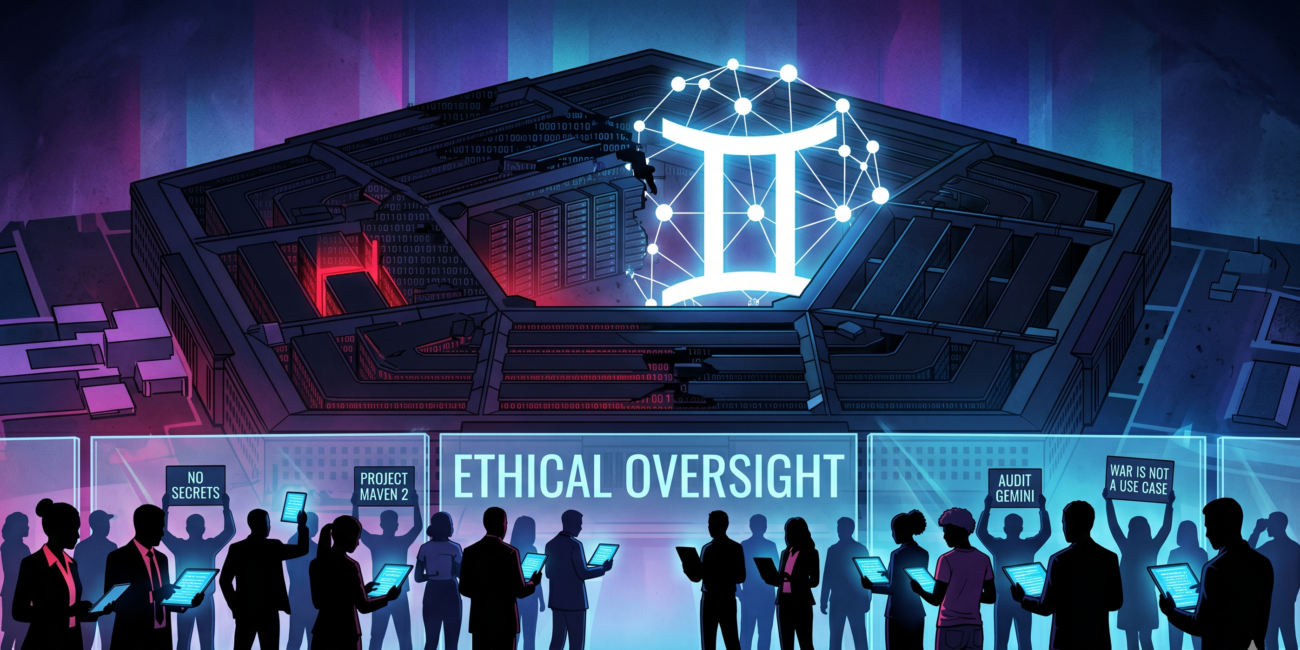
The corridors of Google’s Mountain View headquarters are once again echoing with the sounds of dissent as a massive internal rebellion takes shape. Over 600 employees, comprising some of the world’s most renowned artificial intelligence researchers, engineers, and high-level executives, have united to issue a stark ultimatum to CEO Sundar Pichai. The core of their grievance lies in a proposed, highly classified partnership with the United States Department of Defense. This deal, if finalized, would integrate Google’s most advanced AI model, Gemini, into the heart of American military operations. For the employees, this represents a betrayal of the company’s foundational “Don’t Be Evil” ethos; for the leadership, it is a strategic necessity in an era where AI supremacy is synonymous with national security.
The Shadow of Project Maven and the Breaking of a Promise
To understand the intensity of the current protest, one must look back to 2018. During that period, Google faced a similar crisis known as Project Maven, which involved using Google’s image-recognition technology to assist the Pentagon in analyzing drone footage. The ensuing employee backlash was so severe that it resulted in high-profile resignations and a public pledge from leadership. Google subsequently released its “AI Principles,” a document intended to serve as a moral compass for the company’s future developments. Central to these principles was a commitment that Google would not develop AI for use in weapons or surveillance that violates internationally accepted norms.
However, the 2026 landscape is vastly different from that of 2018. The global race for AI dominance has reached a fever pitch, with billions of dollars in government contracts at stake. Critics within the company argue that Google has slowly been eroding its own ethical boundaries to compete with rivals like Microsoft and Amazon, who have been more aggressive in pursuing defense contracts. The current petition asserts that by entering into “classified” agreements, Google is effectively bypassing its own oversight mechanisms. Because these projects are top-secret, the general workforce—and even most of the engineering teams—cannot verify if the work they do is being weaponized behind a government firewall.
The Technical Dilemma of Air-Gapped Warfare
The primary technical concern raised by the dissenting staff involves the concept of “air-gapped” networks. These are secure, isolated environments where the military processes its most sensitive data, completely cut off from the public internet. If Google provides the Gemini AI framework to be used within these environments, the company loses all “telemetry”—the ability to see how the software is behaving or what it is being used for. In a standard commercial setting, Google can monitor its API usage to ensure no one is using its tools for illegal or harmful purposes. In a classified military setting, that control is surrendered entirely.
This lack of transparency creates a moral “black box.” Researchers fear that their code, originally designed for creative writing or scientific discovery, could be repurposed for lethal autonomous targeting systems or mass profiling of civilian populations in conflict zones. The Department of Defense has reportedly pushed for a “lawful use” clause, which is a broad legal term that could encompass almost any military action deemed legal by the government, regardless of whether it violates Google’s specific AI ethics. This discrepancy in language is the flashpoint of the current debate, with employees arguing that “lawful” and “ethical” are not always the same thing.
The Geopolitical Pressure and the Anthropic Vacuum
The timing of this internal crisis is not accidental. The Pentagon recently distanced itself from Anthropic, another major AI player, labeling the startup a “supply-chain risk” after it refused to remove certain ethical guardrails for military applications. This has left a massive vacuum in the U.S. government’s AI strategy, and Google is seen as the only entity with the computational power and sophisticated modeling to fill the gap. From the perspective of CEO Sundar Pichai and the board, turning down these contracts isn’t just about losing revenue; it’s about ceding the future of national defense technology to competitors or, worse, foreign adversaries.
Furthermore, Google’s financial stakes are higher than ever. The company has invested nearly $180 billion into AI infrastructure over the last year alone. Maintaining this level of capital expenditure requires massive revenue streams, and the public sector remains one of the largest untapped markets for high-end AI services. Leadership is currently caught between the “Social Contract” they have with their elite workforce and the “Fiduciary Duty” they have to their shareholders. Ignoring the 600-strong petition could lead to a catastrophic “brain drain,” where the world’s best AI talent leaves Google for more ethically aligned organizations or academia.
A Cultural Crisis in the Age of Gemini
The dissent is not limited to junior staff; the presence of over 20 directors and vice presidents on the petition signifies a deep-seated cultural rift at the highest levels of the company. These are individuals who have spent decades building Google’s reputation as a pioneer in ethical tech. Their involvement suggests that the internal checks and balances designed to prevent such a crisis have failed. The petition calls for an immediate suspension of all negotiations with the Pentagon until a transparent, third-party ethical audit can be conducted. They are also demanding a “conscientious objector” clause, which would allow any employee to opt-out of working on defense-related code without fear of professional retaliation.
As the debate spills into the public eye, it raises broader questions about the role of “Big Tech” in modern warfare. In the past, the lines between civilian and military technology were clearly defined. Today, a large language model used to help a student write an essay is fundamentally the same technology that can be used to coordinate drone strikes or conduct cyberwarfare. This “dual-use” nature of AI makes the ethical policing of these tools nearly impossible. Google’s internal war is a preview of the challenges every major technology company will face as their products become central to global power dynamics.
The Path Forward: Compromise or Conflict?
As of this writing, Google’s executive leadership has remained largely silent, providing only boilerplate statements about their commitment to their AI Principles. However, the pressure is mounting. The organizing group behind the petition has hinted at potential walkouts or even a coordinated “work-to-rule” strike if their concerns are not addressed in the upcoming quarterly all-hands meeting. Such a move would be devastating for the company’s product timeline, particularly as they prepare to launch the next iteration of Gemini.
The resolution of this conflict will likely set a precedent for the entire industry. If Google successfully integrates its AI into the military while pacifying its workforce, it will provide a roadmap for others to follow. If the employees succeed in blocking the deal, it may force a fundamental restructuring of how tech companies interact with government agencies. Regardless of the outcome, the battle over Google’s military contracts proves that code is no longer just a set of instructions—it is a political and moral statement that can shift the balance of power on the global stage. The eyes of the tech world remain fixed on Sundar Pichai, waiting to see if he will choose the lucrative path of the defense contractor or the principled path demanded by his most valuable assets: his people.