




The Silent Revolution: Navigating the Death of SEO and the Dawn of AI-Driven Discovery
The digital marketing landscape, a domain governed for nearly three decades by the rigid laws of Search Engine Optimization (SEO), is currently witnessing its most profound transformation since the birth of the internet. For years, the recipe for online success was clear: identify high-volume keywords, secure authoritative backlinks, and optimize technical metadata to appease the algorithms of giants like Google. However, as 2026 unfolds, the industry is grappling with a startling new reality. The traditional search bar—a gateway that once offered ten blue links to explore—is being superseded by conversational interfaces. We are witnessing the era of AI Engine Optimization (AEO), a shift that marks not just an evolution of search, but the potential end of SEO as we have historically understood it.
The Erosion of the Traditional Search Paradigm
The foundation of traditional search was built on the concept of “browsing.” A user would input a query, and the search engine would act as a librarian, pointing toward various shelves of information. This necessitated a click-through to a website, allowing brands to capture attention, build trust, and eventually convert a visitor into a customer. This symbiotic relationship between search engines and content creators provided the lifeblood of the open web.
Artificial Intelligence has fundamentally disrupted this cycle. Large Language Models (LLMs) like ChatGPT, Claude, and Gemini have evolved from simple chatbots into “Answer Engines.” Instead of acting as a librarian, these models act as a researcher who has already read every book in the library. When a user asks a question today, the AI synthesizes a comprehensive response on the spot. This “Zero-Click” reality means that the user’s journey often begins and ends within the AI interface. If the AI provides the answer directly, the incentive for the user to visit the source website vanishes, effectively starving traditional websites of the traffic they once relied upon for survival.
From Algorithmic Ranking to LLM Synthesis
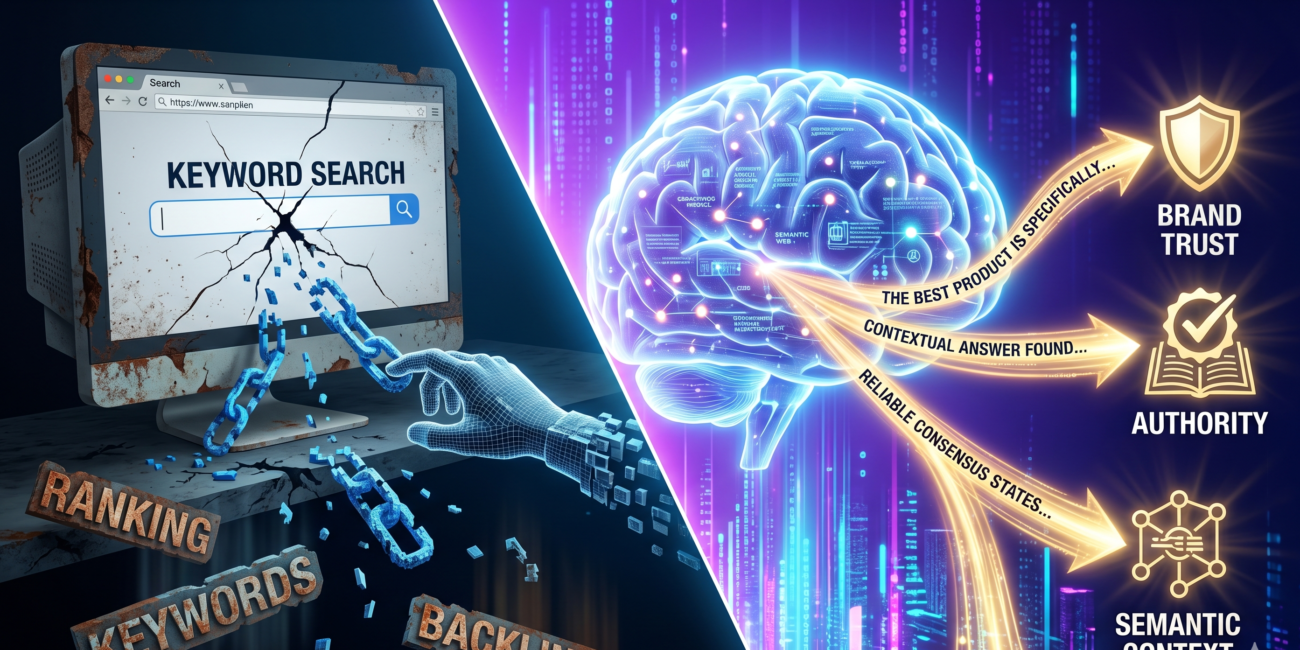
The technical shift from SEO to AEO is profound. SEO was essentially a game of “relevance and authority.” If your page was technically sound and had enough “link juice” from other sites, you ranked at the top. AEO, however, is a game of “synthesis and consensus.” AI models do not just look for the most popular link; they look for the most reliable information that fits the specific context of a user’s prompt.
To be “optimized” for an AI engine, a brand must focus on structured data and semantic clarity. This means moving beyond keyword stuffing and focusing on “Entities.” AI models understand the world in terms of entities—people, places, things, and the relationships between them. For a brand to be discovered in an AI-driven world, it must ensure that the AI “knows” what the brand is, what it stands for, and why it is a credible authority in its niche. This requires a shift toward technical schemas and Knowledge Graphs that allow AI crawlers to instantly categorize and verify the information provided.
The High Stakes of the “Single Answer” Economy
Perhaps the most terrifying aspect of the shift to AI discovery for marketers is the narrowing of the funnel. In the old world of SEO, being in the top three results was excellent, but even being on the first page offered a chance at visibility. The “long tail” of search allowed thousands of small players to find their audience. In the new world of AI synthesis, the engine often provides a single, definitive answer or a very short list of two or three citations.
This creates a “winner-takes-all” environment. If a consumer asks an AI assistant for the best sustainable running shoes, the AI might mention two brands it considers the most authoritative based on its training data. For the hundreds of other sustainable shoe brands that might have ranked on page one of Google, the AI’s silence is equivalent to digital non-existence. This shift places a premium on “Brand Authority” that far outweighs any technical SEO trickery. Brands can no longer “buy” their way to the top with aggressive link-building; they must earn their way into the training data of the models by being genuinely mentioned and cited by other authoritative voices across the web.
Personalization and the Death of Universal Ranking
Another pillar of the SEO era was the “Universal Ranking.” While search results were slightly personalized based on location, for the most part, everyone searching for “best digital cameras” saw the same top results. AI discovery is shattering this uniformity. Because AI assistants have access to a user’s previous conversations, preferences, and even their behavioral data, the “answer” they provide will be hyper-personalized.
An AI assistant might recommend a different camera to a professional photographer than it would to a travel vlogger, even if they use the same prompt. This means that brands can no longer aim for a single “number one” spot. Instead, they must focus on “Niche Dominance.” The goal is to be the undisputed answer for a very specific type of user persona. This necessitates a move away from broad, generic content toward highly specialized, high-utility content that solves specific problems for specific people. The focus of brand discovery is moving from “being found” to “being the right fit.”
The Future of Monetization and the Open Web
As AI engines continue to absorb the traffic that once flowed to publishers and brands, the very business model of the internet is under threat. If websites stop receiving traffic, they stop generating ad revenue. If they stop generating revenue, they stop producing the high-quality content that AI models need to train on. This “Ouroboros” effect—where the AI consumes the very thing it needs to survive—is a major concern for the future of the web.
We are likely to see a shift toward “Gated Discovery” and “Direct Attribution.” Brands may begin to strike deals directly with AI companies to ensure their products are featured in recommendations, similar to how grocery stores charge “slotting fees” for shelf space. Alternatively, we may see the rise of “Verifiable Web” technologies where content creators use blockchain or digital signatures to prove the authenticity of their data, making it more attractive for AI models that are increasingly wary of “hallucinations” and AI-generated “slop.”
Conclusion: Adapting to the Post-Search Era
The end of SEO does not mean the end of marketing; it means the end of a specific type of digital manipulation. The era of AEO is an invitation for brands to return to the fundamentals of high-quality communication. To survive the transition, companies must stop treating their websites as collections of keywords and start treating them as authoritative data sources.
The successful brand of 2026 will be the one that focuses on building a “Consensus of Trust.” They will produce content that is so useful and so widely cited by human experts that an AI model cannot help but include it in its synthesized answers. While the search bar may be fading, the human desire for discovery remains as strong as ever. The medium has changed from the blue link to the AI voice, and the winners will be those who learn to speak the new language of the machine while maintaining the soul of their brand. The transition from SEO to AEO is not just a technical update; it is a fundamental reimagining of how the world finds what it needs, and it marks the most exciting—and dangerous—period in the history of digital media.