





Apple Accelerates Hardware Future as iPhone 18 Pro Camera Modules and Ultra Series Features Enter Early Development Phases
The global technology landscape is currently fixated on the upcoming shifts in mobile architecture as Apple reportedly fast-tracks the development of its 2026 flagship lineup. Moving beyond the iterative updates seen in previous cycles, the Cupertino giant has officially transitioned the specialized camera components for the iPhone 18 Pro into an active production and testing stage. This strategic acceleration signals a fundamental pivot in Apple’s hardware philosophy, emphasizing physical mechanical innovation alongside its industry-leading computational photography suites. By initiating these production lines significantly ahead of the traditional schedule, Apple is positioning the iPhone 18 Pro to be the most substantial leap in optical engineering since the introduction of the multi-lens system.
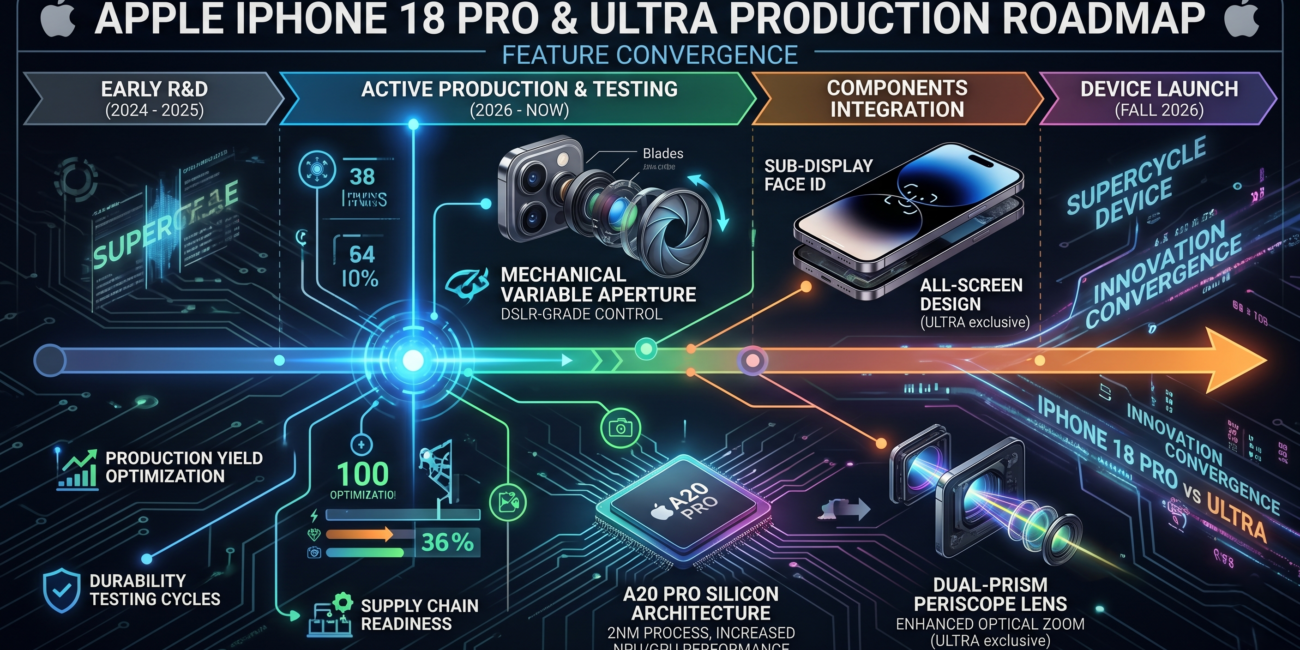
The primary catalyst for this early production push is the ambitious integration of a mechanical variable aperture system for the primary camera sensor. For nearly a decade, smartphone manufacturers have relied almost exclusively on fixed-aperture lenses, using sophisticated software algorithms to simulate the depth of field and light intake adjustments found in professional DSLR cameras. The iPhone 18 Pro aims to disrupt this reliance on software by introducing physical blades within the lens assembly. This mechanical system will allow the device to physically widen or narrow the aperture, providing users with authentic control over light exposure and natural background blur. Implementing such a delicate mechanical system within the constrained internal volume of a modern smartphone requires unprecedented precision, explaining why Apple has moved these components into the factory testing phase so early in the cycle.
As the iPhone 18 Pro moves through these production milestones, internal reports have also begun to shed light on how Apple plans to differentiate its top-tier devices, specifically contrasting the iPhone 18 Pro with a potential new “Ultra” category. The strategy appears to be built on three major pillars of innovation designed to convince even the most hesitant users to upgrade their hardware. The first of these pillars focuses on the evolution of the display and biometric security. While the standard Pro models are expected to refine the existing Dynamic Island interface, the high-end Ultra variant is rumored to be the staging ground for Apple’s first true all-screen design. This would involve moving the Face ID sensors entirely beneath the display panel, removing the visual cutout and achieving a seamless glass aesthetic that has been a long-term goal for the company’s design team.
The second pillar of this upgrade cycle involves the introduction of the A20 Pro silicon architecture, which is expected to be built on a cutting-edge 2nm process. This new chip will not only offer the standard year-over-year gains in energy efficiency and processing speed but will also likely feature a specialized core configuration for the higher-end models. There is strong speculation that the Ultra tier will utilize a high-performance version of the A20 Pro, featuring additional GPU cores and a significantly beefed-up Neural Engine. These enhancements are specifically tailored to handle the massive data throughput required for real-time AI video editing and high-fidelity mobile gaming, ensuring that the hardware remains capable of supporting next-generation software features for many years.
Optical zoom technology serves as the third pillar in Apple’s hardware roadmap. While the iPhone 18 Pro will benefit from the new variable aperture main sensor, the Ultra model is being developed with an exclusive dual-prism periscope lens system. This advanced configuration is intended to push the boundaries of optical zoom beyond the current industry standards, allowing for crystal-clear magnification at distances that were previously only possible with digital cropping. By reserving this extreme telephoto capability for the Ultra model, Apple is creating a clear hierarchy of photographic power, catering to professional creators who require the absolute best tools available in a mobile form factor.
The decision to move into active production this early also reflects a renewed focus on hardware durability and supply chain resilience. The inclusion of moving parts, such as variable aperture blades, introduces new points of potential mechanical failure that fixed-lens systems do not face. To ensure that these devices meet Apple’s rigorous quality standards, the company is conducting extensive stress tests on these modules under various environmental conditions. This early start allows the engineering teams to identify and rectify any manufacturing defects or design flaws long before the mass production of the finished handsets begins. It is a proactive approach that seeks to avoid the technical hurdles encountered by other manufacturers who have attempted mechanical lens systems in the past.
Furthermore, the competitive landscape of 2026 is expected to be more aggressive than ever, with rival manufacturers pushing the limits of sensor size and artificial intelligence integration. By locking in these hardware breakthroughs now, Apple is securing its supply chain and ensuring that it has the necessary components to meet what is expected to be record-breaking demand. The iPhone 18 Pro and its Ultra counterpart are being designed as “supercycle” devices—products so advanced that they compel users who typically hold onto their phones for four or five years to finally make the switch. The combination of 2nm silicon, sub-display biometrics, and mechanical camera systems represents a convergence of three major technology curves, all hitting maturity at the same time.
From a consumer perspective, these developments suggest that the era of incremental smartphone updates is coming to an end, replaced by a period of significant mechanical and architectural reinvention. The iPhone 18 Pro is not just a faster version of its predecessor; it is a fundamental reimagining of what a mobile camera can be. The transition from software-simulated effects to physical, mechanical adjustments marks a return to the principles of traditional photography, albeit miniaturized for the modern age. As these components continue to roll off the production lines and enter the final stages of integration, the tech world remains poised for a launch that could redefine the premium smartphone segment for the remainder of the decade. The early activity in Apple’s production facilities is a loud signal that the company is ready to “Never Settle” on its vision for the future of mobile technology.