




The Architect, the Engineer, and the Astronaut: How Gabe Newell and Elon Musk Almost Sent Hideo Kojima to Space
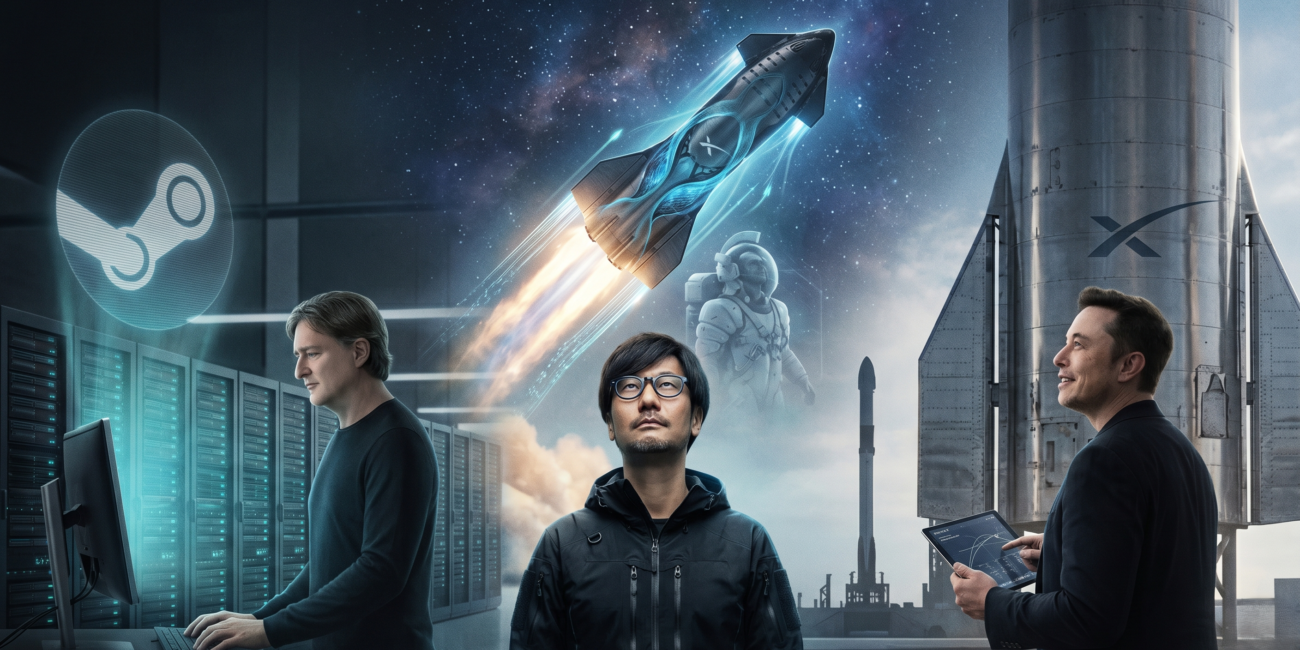
In the fast-moving intersection of global technology, high-stakes litigation, and creative genius, it is rare to find a story that bridges the gap between a corporate lawsuit and a childhood dream. However, the ongoing legal battle between Elon Musk and OpenAI has inadvertently pulled back the curtain on an extraordinary exchange from 2018. This revelation involves three of the most influential figures of the modern era: Valve founder Gabe Newell, legendary game designer Hideo Kojima, and SpaceX CEO Elon Musk. Newly surfaced emails show that at the height of development for the genre-defying game Death Stranding, the industry’s most powerful figures were conspiring to fulfill Kojima’s lifelong ambition of visiting the stars.
The story began to circulate following the public release of internal communications used as evidence in Musk’s lawsuit against Sam Altman and OpenAI. While the primary focus of the legal proceedings remains on the direction of artificial intelligence and corporate ethics, one particular email thread from October 2018 captured the attention of the gaming community. It depicts Gabe Newell, the reclusive but revered leader of Valve, acting as a bridge between the worlds of digital entertainment and aerospace engineering. After hosting Kojima at Valve’s headquarters, Newell reached out to Musk with a specific, personal request that transcended standard business networking.
According to the correspondence, Kojima had recently showcased his latest projects to Newell. During their time together, the conversation shifted from the mechanics of game design to the frontiers of human exploration. Newell noted that Kojima was deeply fascinated by two things: the future of artificial intelligence and the physical reality of space travel. In his message to Musk, Newell described Kojima as a visionary who had a profound desire to see the inner workings of SpaceX. The email was not just a professional introduction; it was an attempt to facilitate a meeting of minds between the man who revolutionized storytelling in games and the man attempting to make humanity multi-planetary.
The significance of this request cannot be overstated when considering Hideo Kojima’s personal history. The creator of the Metal Gear series has long been vocal about his obsession with the cosmos. In his published essays and various interviews, Kojima has described space as the ultimate frontier for human creativity. He once famously remarked that if given the opportunity, he would willingly leave his career behind for the chance to orbit the Earth. His fascination with the “great void” is a recurring theme in his work, from the lunar landscapes and astronaut-like aesthetics of the Ludens mascot to the sprawling, desolate environments of Death Stranding. For Kojima, space is not just a setting for a science fiction story; it is a spiritual goal.
Elon Musk’s response to Newell’s inquiry was remarkably swift and welcoming. The billionaire entrepreneur, who was at the time navigating the immense pressure of scaling Tesla and SpaceX while dealing with the early fractures in his relationship with OpenAI, expressed an immediate interest in meeting Kojima. Musk replied that he would be happy to host the designer at the SpaceX rocket factory in Hawthorne, California. He encouraged Newell to pass along his direct contact information, effectively opening the door for a collaboration between the world’s leading private space agency and the gaming industry’s most prominent auteur.
The timing of this exchange is particularly poignant. In late 2018, Kojima Productions was in the final, grueling stages of developing Death Stranding. The game itself deals heavily with themes of isolation, connection, and the survival of the human species against an existential threat—concepts that align closely with Musk’s stated mission for SpaceX. The potential for these two figures to discuss the “Death Stranding” of society and the “Lifeline” of space travel represents a unique cultural moment where art and engineering converge. Furthermore, Kojima has often expressed a desire to be the first person to create a digital work of art while in space. He has envisioned a future where he could develop a game on the International Space Station, merging the physical experience of weightlessness with the digital experience of gameplay.
However, despite the enthusiastic “yes” from Musk and the mediation of Newell, the dream proved difficult to materialize. In subsequent years, the world was gripped by a global pandemic, and both Musk and Kojima found themselves buried under massive logistical projects—Musk with the rapid expansion of Starlink and Starship, and Kojima with the launch of his independent studio’s debut title and the subsequent planning of its sequel. In a 2020 interview, Kojima admitted that while the offer from Newell and the connection to Musk were genuine and highly appreciated, the actual tour of the rocket factory had not yet taken place. The complexities of international travel, high-level security clearances, and conflicting schedules had kept the visionary grounded for the time being.
The legal documents that brought this story to light also provide a fascinating look at the mindset of these leaders during that era. While the email about Kojima was a moment of levity, the surrounding messages show Musk’s growing frustration with the direction of OpenAI. He expressed to Newell his belief that the organization was falling behind competitors like Google and DeepMind, and that his focus was shifting toward the integration of AI within Tesla’s hardware. This context makes the Kojima introduction even more striking; amidst the stress of a changing technological landscape and the birth of a new era of AI, these men still found time to discuss the simple, human wonder of going to space.
For fans of Kojima’s work, this revelation adds another layer of depth to his upcoming projects, specifically Death Stranding 2: On The Beach and his mysterious collaboration with Xbox, OD. Observing how Kojima’s real-world interactions with figures like Newell and Musk influence his creative output is a subject of constant fascination. There is a sense of “art imitating life” when a man who writes about characters wearing high-tech suits and navigating alien-like terrains is actively seeking entry into the world’s most advanced rocket facility.
Ultimately, the story of the email exchange serves as a reminder of the power of networking and the mutual respect that exists at the highest levels of creative and technical industries. Gabe Newell, a man who built an empire on the distribution and development of games, saw a kindred spirit in Kojima and sought to use his influence to help a friend achieve a dream. Elon Musk, regardless of the controversies that often surround his public persona, recognized the value of Kojima’s perspective and opened his doors.
As of 2026, Kojima remains on Earth, but his eyes are still fixed on the stars. The public disclosure of these emails has reignited interest in the possibility of a “Kojima in Space” project. Whether it is a tour of a factory or a seat on a future commercial flight, the connection established by Gabe Newell has ensured that the bridge between the gaming world and the aerospace industry remains open. For Hideo Kojima, the journey to the launchpad may be longer than a digital loading screen, but the support of his peers suggests that his ultimate creative frontier is closer than ever before. This small fragment of a larger legal battle has given the world a glimpse into a moment where the business of technology took a backseat to the pursuit of human wonder.