




Google Launches Fitbit Air: A New Screenless Fitness Tracker Powered by AI Health Coaching
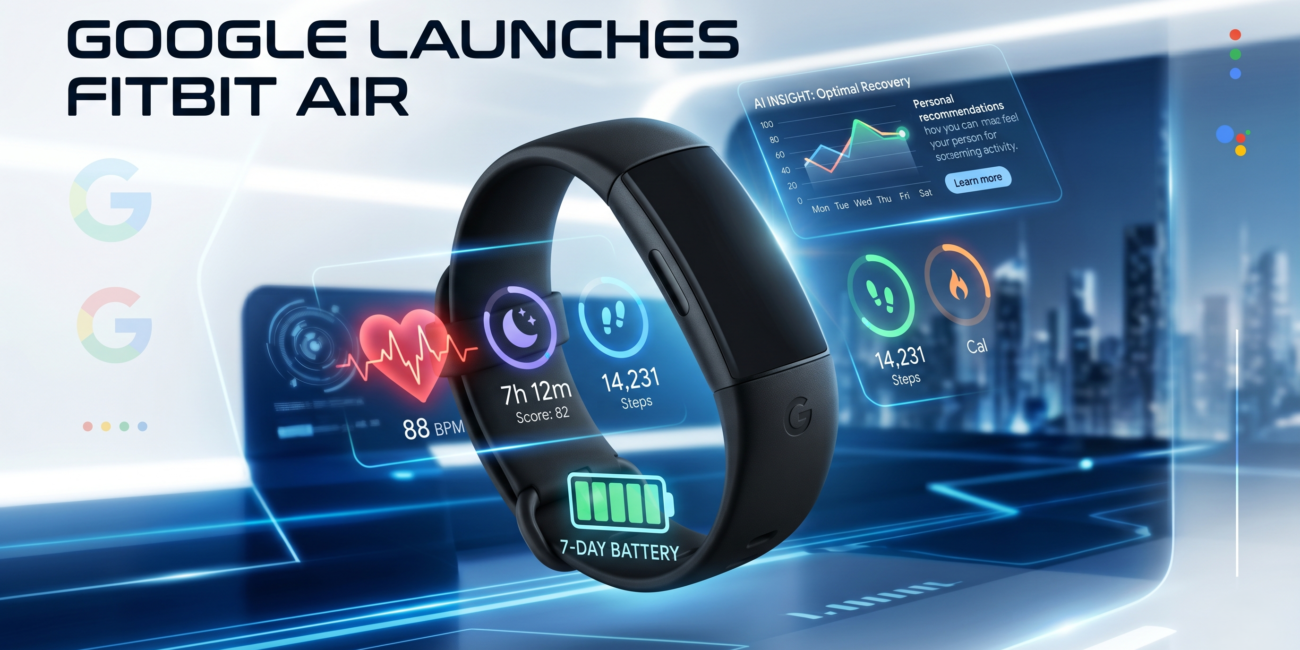
Google has officially entered a new phase of wearable technology with the launch of Fitbit Air, a screenless fitness tracker designed to focus entirely on health, wellness, and AI-powered coaching. The newly introduced wearable takes a very different approach from traditional smartwatches by removing the display altogether and emphasizing passive health tracking, longer battery life, and personalized artificial intelligence insights.
The launch signals Google’s growing ambition in the AI health and wearable technology market. Instead of competing directly with feature-heavy smartwatches, Fitbit Air is designed for users who want a lightweight and distraction-free health companion that quietly tracks their fitness and recovery throughout the day.
The company believes many consumers are becoming overwhelmed with notifications, apps, and screen time. Fitbit Air attempts to solve that problem by returning to the simplicity of early fitness bands while adding modern AI capabilities powered by Google’s ecosystem.
A Different Vision for Wearable Technology
Unlike most modern fitness devices, Fitbit Air does not include a screen. Users cannot view messages, notifications, apps, or even live workout statistics directly on the device. Google says this minimalist approach is intentional and reflects a broader shift toward “ambient wellness technology,” where devices work silently in the background instead of demanding constant attention.
The company describes Fitbit Air as a health-first wearable rather than a smartwatch. It is aimed at users who want meaningful health insights without the distractions associated with larger smart devices.
The absence of a screen also helps make the tracker smaller, lighter, and more power-efficient. Weighing only around 12 grams, Fitbit Air is one of the lightest fitness wearables introduced by Google in recent years.
The design has already drawn comparisons with other minimalist health-focused wearables such as Whoop and Oura, both of which focus heavily on recovery tracking and passive wellness monitoring.
AI Health Coaching Becomes the Main Attraction
One of the biggest highlights of Fitbit Air is its integration with Google’s AI-powered health coaching system. The wearable uses Google’s Gemini AI technology to analyze user health data and deliver personalized fitness recommendations.
Instead of simply showing raw numbers like steps or calories burned, Fitbit Air attempts to provide actionable guidance. The AI system studies patterns related to sleep, heart rate, recovery levels, workout intensity, and overall activity. Based on that information, users receive adaptive workout suggestions, recovery advice, wellness recommendations, and weekly fitness goals.
Google says the AI coaching experience is designed to feel more like a digital wellness companion rather than a standard fitness app. The system can reportedly suggest when users should rest, exercise harder, improve sleep habits, or reduce stress levels.
This marks a major step in Google’s effort to combine artificial intelligence with consumer health products. AI-powered fitness coaching is becoming one of the fastest-growing categories in wearable technology, and Fitbit Air positions Google directly in that space.
Comprehensive Health Tracking Features
Despite its compact and screenless design, Fitbit Air includes several advanced health tracking capabilities. The wearable continuously monitors heart rate throughout the day and night while also tracking Heart Rate Variability, a metric commonly associated with recovery and stress management.
The tracker also supports blood oxygen monitoring, sleep analysis, body temperature variation tracking, and irregular heart rhythm detection. These features are becoming increasingly important as wearable devices expand beyond fitness into preventive health monitoring.
Sleep tracking is expected to be one of Fitbit Air’s strongest features. Google says the AI system uses sleep quality data to provide recovery scores and personalized wellness recommendations. Users may receive advice related to bedtime habits, stress recovery, or workout timing based on their sleep performance.
The device also supports automatic workout recognition, meaning it can detect certain activities without users needing to manually start tracking sessions. Additional features include haptic vibration alerts, smart wake alarms, and water resistance up to 50 meters.
However, Fitbit Air does not include built-in GPS, which may disappoint users who prefer detailed outdoor activity tracking. The absence of smartwatch features such as mobile payments, calling support, or notification systems also reinforces the device’s minimalist philosophy.
Seven-Day Battery Life Offers Major Advantage
Battery performance is another area where Fitbit Air attempts to stand out from traditional smartwatches. Google claims the wearable can deliver up to seven days of battery life on a single charge.
This is significantly longer than many modern smartwatches, which often require daily charging because of their displays and app-heavy systems. By eliminating the screen and focusing on background tracking, Fitbit Air achieves much greater power efficiency.
The company also says the device supports fast charging, with a full charge taking approximately 90 minutes. Long battery life has become one of the most important factors for health-focused wearables, especially for users who want uninterrupted sleep and recovery tracking.
Google Expands Health Ecosystem Beyond Android
Another important aspect of the launch is iPhone compatibility. Fitbit Air works with both Android and iOS devices, allowing Google to expand its AI health ecosystem beyond its own smartphone platform.
This strategy could help Google reach millions of Apple users who may be interested in AI-powered wellness tracking without purchasing an Apple Watch. Cross-platform support also increases Fitbit Air’s appeal in the broader wearable market.
Google has reportedly positioned the device as a companion product rather than a replacement for its Pixel Watch lineup. While the Pixel Watch focuses more on smartwatch functionality, Fitbit Air is aimed at users who prioritize wellness, recovery, and passive health monitoring.
Pricing and Subscription Strategy
Fitbit Air has been launched with a starting price of $99, making it more affordable than many premium health-focused wearables currently available in the market.
However, several advanced AI coaching features are tied to Google’s Health Premium subscription service. The subscription costs $10 per month or $100 annually. Buyers of Fitbit Air will receive three months of free premium access after purchase.
This subscription model reflects a growing trend in the wearable industry, where companies increasingly rely on recurring revenue through AI coaching and advanced health analytics rather than hardware sales alone.
Pre-orders for Fitbit Air have already started, while official sales are expected to begin later this month.
Privacy Concerns Around AI Health Data
As with many AI-powered health products, privacy concerns have also emerged following the announcement. Some experts have questioned how sensitive health data collected by Fitbit Air will be stored and used in the future.
Google has stated that Fitbit health data will not be used for advertising purposes. The company also reminded users that commitments made during its Fitbit acquisition prevent the use of Fitbit health information in Google ads systems for a fixed period.
Still, privacy advocates argue that large-scale health data collection always carries potential risks, particularly as AI systems become more advanced and interconnected.
The debate around digital health privacy is expected to intensify as companies continue integrating artificial intelligence into wearable technology.
The Future of Minimalist AI Wearables
The launch of Fitbit Air highlights a major shift happening in the wearable technology industry. For years, companies focused on adding more screens, more apps, and more smartwatch features. Google is now exploring the opposite direction by reducing distractions and emphasizing intelligent health guidance instead.
Fitbit Air represents a broader industry movement toward passive wellness monitoring and AI-driven personalization. Rather than constantly interacting with users, these devices are designed to quietly collect data and provide meaningful recommendations when needed.
Whether consumers fully embrace the screenless concept remains to be seen, but Google’s latest wearable clearly signals that the future of fitness technology may rely less on hardware displays and more on intelligent software experiences.
With AI becoming central to health and wellness products, Fitbit Air could become an important step in redefining how people interact with wearable devices in the coming years.