



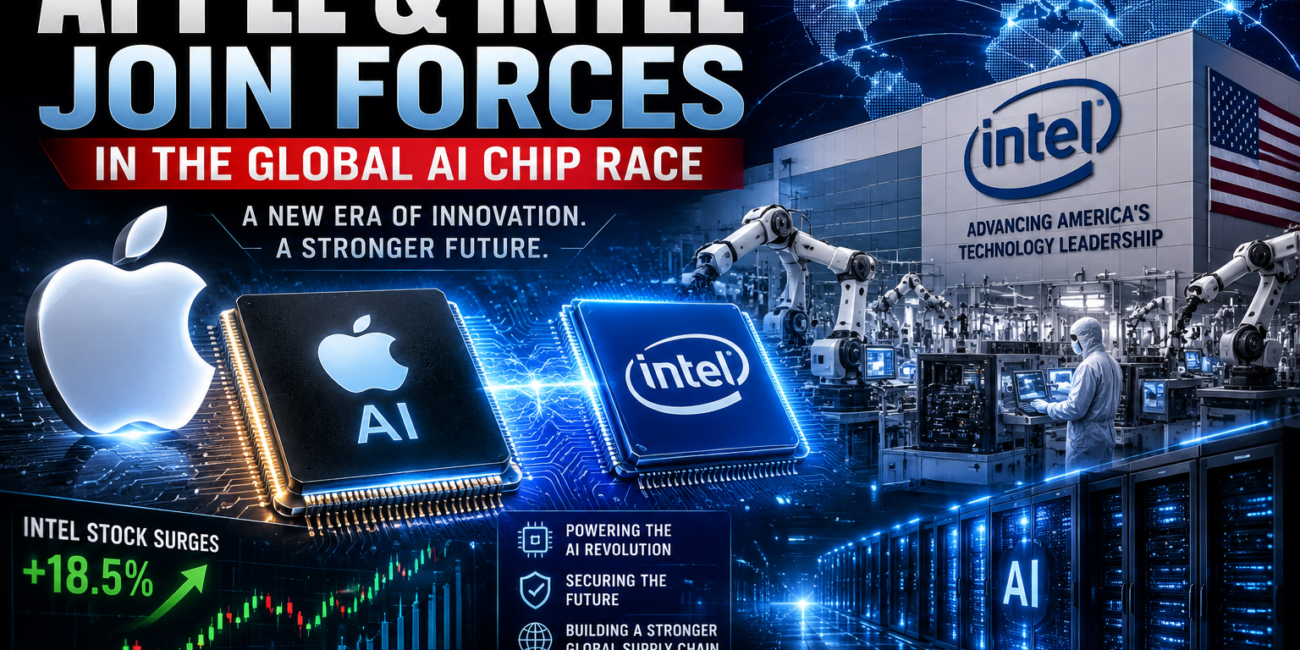
Apple and Intel Shock the Tech Industry With New Chip Partnership Amid the Exploding AI Race
The global semiconductor industry may be entering a completely new era after reports revealed that Apple and Intel have reached a preliminary agreement for Intel to manufacture future Apple chips. The unexpected partnership has already shaken Wall Street, fueled speculation across Silicon Valley, and intensified the rapidly growing global competition surrounding artificial intelligence infrastructure.
For years, Apple and Intel were considered former allies turned rivals after Apple abandoned Intel processors in favor of its own Apple Silicon chips in 2020. The move was seen as one of the biggest transformations in modern computing, allowing Apple to gain greater control over performance, battery efficiency, and product design. Apple’s M-series chips quickly became some of the most respected processors in the industry, while Intel struggled with manufacturing delays and increasing pressure from competitors like AMD, Nvidia, and Taiwan Semiconductor Manufacturing Company (TSMC).
Now, in a dramatic twist, the two companies appear ready to work together again — but this time for a very different reason. According to recent reports, Apple is exploring the possibility of using Intel’s growing foundry business to manufacture future chips for some of its devices. Although the deal is still in its early stages, analysts believe the implications could reshape the future of the global chip industry.
The announcement immediately sparked excitement in financial markets. Intel shares surged sharply after the news surfaced, with investors viewing the potential Apple partnership as one of the strongest signs yet that Intel’s turnaround strategy may finally be working. Apple shares also moved higher, as investors interpreted the move as a strategic effort to reduce the company’s dependence on a single supplier during a time of rising geopolitical uncertainty and exploding AI demand.
At the center of this story is the growing pressure being created by artificial intelligence. Over the last two years, the AI boom has transformed the semiconductor industry into one of the most strategically important sectors in the world economy. Companies are now racing to secure enough computing power to support advanced AI models, cloud infrastructure, robotics, autonomous systems, and next-generation consumer devices.
Nvidia has become the dominant force in AI chips, while companies such as Microsoft, Google, Amazon, Meta, and Tesla continue investing billions into AI infrastructure. This unprecedented demand has placed enormous pressure on global chip manufacturers, especially TSMC, which currently produces many of the world’s most advanced processors.
Apple has relied heavily on TSMC for years, using the Taiwanese company to manufacture the powerful chips that run iPhones, iPads, and Mac computers. However, the AI revolution is creating new challenges. TSMC’s manufacturing capacity is increasingly being consumed by AI-focused companies competing for advanced chips. As a result, major technology companies are searching for additional manufacturing partners to reduce supply risks and secure long-term production stability.
That is where Intel enters the picture.
Under its foundry expansion strategy, Intel has been aggressively attempting to reinvent itself as a global chip manufacturing powerhouse capable of competing directly with TSMC and Samsung. The company has invested tens of billions of dollars into advanced fabrication plants across the United States and Europe while promoting itself as a crucial player in rebuilding Western semiconductor independence.
Intel’s leadership has repeatedly emphasized that the future of technology and artificial intelligence cannot depend entirely on overseas manufacturing. The company’s foundry ambitions have also aligned closely with the goals of the U.S. government, which has been pushing aggressively to strengthen domestic semiconductor production after years of supply chain disruptions and geopolitical tensions involving China and Taiwan.
Reports suggest that government officials quietly supported discussions between Apple and Intel because such a partnership would represent a major victory for America’s domestic chip ambitions. Bringing Apple — one of the world’s most influential technology companies — into Intel’s foundry ecosystem would significantly boost confidence in U.S.-based semiconductor manufacturing.
The timing of the deal is also important because the global AI race is accelerating at an extraordinary pace. Nations and companies are increasingly viewing artificial intelligence as a strategic priority comparable to energy, defense, or telecommunications infrastructure. The companies that control advanced computing power could ultimately dominate future industries ranging from robotics and healthcare to transportation and military systems.
This environment has created enormous pressure on semiconductor supply chains. Chip manufacturing is no longer simply a business issue; it has become a geopolitical and national security concern.
For Intel, the Apple partnership could represent one of the most important moments in the company’s modern history. Once considered the undisputed leader of the semiconductor world, Intel spent several years losing momentum while competitors advanced more rapidly in chip design and manufacturing efficiency. Apple’s decision to abandon Intel processors in Macs several years ago symbolized the company’s decline in consumer technology leadership.
Now, however, Intel may be positioning itself for a comeback by focusing less on traditional PC processors and more on advanced chip manufacturing services and AI infrastructure. Analysts believe that securing Apple as a foundry customer would send a powerful message to the market that Intel is once again becoming relevant at the highest levels of the semiconductor industry.
Despite the excitement, several questions remain unanswered. Industry experts believe Apple is unlikely to immediately shift its most advanced iPhone processors away from TSMC, which still maintains a major lead in cutting-edge manufacturing technology. Instead, Intel could initially manufacture lower-end or secondary chips for Apple products while gradually proving its capabilities over time.
Some analysts speculate that Intel may eventually help produce future versions of Apple’s M-series chips for entry-level devices or AI-focused hardware products expected later this decade. Others believe Apple’s interest in Intel is primarily about diversification rather than replacing TSMC entirely.
Regardless of the final structure of the partnership, the news demonstrates how rapidly the AI revolution is reshaping alliances across the technology industry. Companies that were once direct competitors are increasingly being forced to cooperate due to the massive infrastructure demands created by artificial intelligence.
The development also highlights the growing importance of semiconductor manufacturing in determining global technological leadership. Over the next decade, the ability to produce advanced chips at scale could become one of the most valuable strategic advantages in the world economy.
Meanwhile, the broader AI race continues to intensify beyond Apple and Intel alone. Elon Musk’s expanding AI ambitions through companies connected to Tesla, xAI, and SpaceX have added even more urgency to the battle for computing resources. Major corporations are now competing not only for software dominance but also for access to the physical infrastructure required to train and operate next-generation AI systems.
As AI models become larger and more computationally expensive, the demand for advanced chips is expected to rise dramatically. This could further transform companies like Intel from struggling legacy firms into critical pillars of the future AI economy.
For Apple, the partnership signals a pragmatic strategy focused on long-term resilience. The company understands that maintaining leadership in the AI era will require secure access to massive amounts of semiconductor capacity. Relying too heavily on a single manufacturing partner may no longer be sustainable in a world where AI demand is exploding and geopolitical risks continue to rise.
For Intel, the stakes could not be higher. Successfully producing chips for Apple would not only generate billions in potential revenue but could also restore confidence in Intel’s long-term vision as a global manufacturing leader.
The semiconductor industry has already experienced several major transformations over the last decade, but the AI revolution may trigger the largest shift yet. As Apple and Intel move closer toward a renewed partnership, the global technology landscape could be entering a new chapter defined by artificial intelligence, strategic manufacturing alliances, and an increasingly intense battle for computational power.
What once seemed impossible — Apple returning to Intel — is now becoming one of the most talked-about developments in the modern tech industry.