



Apple Raises MacBook and iPad Prices as AI-Driven Memory Shortage Pushes Manufacturing Costs Higher
Apple Passes Rising Memory Costs to Consumers as Artificial Intelligence Reshapes the Technology Supply Chain
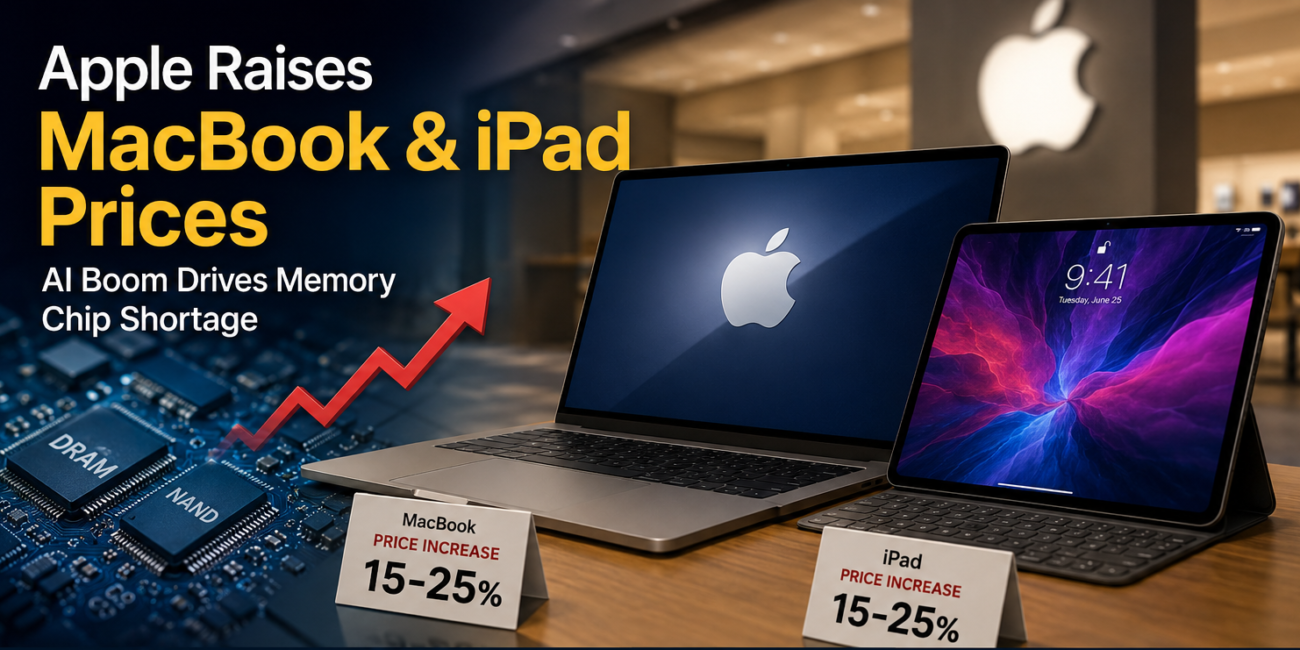
Apple has announced price increases for several MacBook and iPad models, marking one of the company’s most significant pricing adjustments in recent years. The move comes as the global technology industry faces soaring memory chip costs driven by the explosive growth of artificial intelligence. As AI companies continue investing billions of dollars in data centers and advanced computing infrastructure, the demand for high-performance memory has reached unprecedented levels, creating supply shortages that are now affecting consumer electronics.
The latest price adjustments highlight how the AI revolution is extending beyond software and cloud services to influence the prices consumers pay for everyday devices. Industry analysts believe this trend could continue if component shortages persist, potentially affecting a broader range of technology products over the coming months.
AI Boom Creates Unprecedented Demand for Memory Chips
Artificial intelligence has become one of the fastest-growing sectors in the technology industry. Companies developing large language models, AI assistants, autonomous systems, and enterprise AI solutions require massive computing power to train and operate these technologies. One of the most important components supporting these workloads is high-capacity memory.
Modern AI servers rely on advanced DRAM, NAND flash storage, and high-bandwidth memory (HBM) to process enormous datasets efficiently. As technology giants continue expanding their AI infrastructure, manufacturers are struggling to keep pace with demand. Memory suppliers are increasingly prioritizing production for AI-focused hardware, leaving fewer components available for traditional consumer electronics.
This shift has caused memory prices to climb sharply over the past several months. Manufacturers that depend on these components—including Apple—have seen production costs rise significantly, making it increasingly difficult to maintain previous pricing levels without affecting profitability.
MacBook and iPad Prices Reflect Higher Component Costs
The latest pricing changes primarily affect Apple’s MacBook and iPad product lines, both of which depend heavily on premium memory configurations. Depending on the model and storage option, customers may now pay noticeably more than they would have only a few months ago.
Although Apple has not attributed the increases to a single factor, industry experts widely agree that higher memory costs are playing a central role. Unlike routine annual pricing adjustments linked to new product launches, these increases are largely connected to the changing economics of hardware manufacturing.
Apple has traditionally maintained relatively stable pricing for its products while absorbing fluctuations in component costs whenever possible. However, the sustained rise in memory prices appears to have reached a point where passing part of those costs on to consumers has become unavoidable.
Apple’s Long-Term Strategy Faces New Challenges
For years, Apple has built its reputation around delivering premium hardware with carefully managed pricing strategies. The company often negotiates long-term agreements with suppliers, helping protect itself from short-term market volatility. Even so, the current AI-driven demand surge has created conditions unlike anything the industry has experienced before.
Memory suppliers are allocating a larger share of their production capacity toward AI servers because these products generate significantly higher profit margins than memory designed for laptops and tablets. This has reduced available supply for consumer devices and intensified competition among manufacturers seeking components.
Despite Apple’s purchasing power and strong relationships with suppliers, the company is not immune to broader industry trends. As production costs continue increasing, maintaining previous retail prices becomes increasingly difficult without reducing profit margins.
AI Infrastructure Investment Is Reshaping the Semiconductor Market
The rapid expansion of AI infrastructure has transformed the global semiconductor industry. Major technology companies are investing tens of billions of dollars to build advanced data centers capable of training increasingly sophisticated AI models. These facilities require thousands of high-performance GPUs working together, supported by enormous amounts of memory.
Every AI server contains significantly more memory than traditional computing systems. As organizations deploy larger AI clusters, the total demand for DRAM and high-bandwidth memory continues to rise. Semiconductor manufacturers are responding by shifting production priorities toward components specifically designed for AI applications.
While this transition supports innovation in artificial intelligence, it also creates ripple effects throughout the broader electronics market. Manufacturers producing laptops, tablets, gaming devices, and enterprise hardware must compete for a more limited supply of memory components, placing upward pressure on production costs across the industry.
Consumers May Feel the Impact Beyond Apple
Although Apple is among the first major consumer electronics companies to implement noticeable price increases, analysts believe the broader market could eventually experience similar challenges. Companies manufacturing Windows laptops, Android tablets, gaming consoles, and other connected devices rely on many of the same memory suppliers.
If component prices continue rising throughout the remainder of the year, manufacturers across multiple product categories may be forced to reconsider pricing strategies. Consumers shopping for new computers or tablets could encounter higher prices regardless of the brand they choose.
Technology companies may also attempt to offset rising costs through alternative approaches, including offering fewer base storage options, introducing revised hardware configurations, or delaying product refresh cycles until supply conditions improve.
iPhone Prices Remain Stable for Now
One notable aspect of Apple’s latest pricing decision is that iPhone models have not experienced similar increases. Analysts suggest the company is deliberately protecting its flagship smartphone business because of intense global competition and the strategic importance of maintaining strong iPhone sales.
However, experts caution that current pricing should not be interpreted as a guarantee for future product launches. If memory shortages continue or component costs rise further, Apple could eventually revise pricing for future iPhone generations as well.
The company’s ability to keep smartphone prices stable will depend on supplier agreements, manufacturing efficiencies, and the overall direction of semiconductor markets over the coming months.
Investors React to Pricing Changes
Financial markets responded cautiously following reports of Apple’s pricing adjustments. Investors are weighing two competing factors: higher product prices may help Apple preserve profit margins, but they could also reduce consumer demand in an already competitive electronics market.
Premium devices such as MacBooks and iPads often represent significant purchases for consumers, particularly during periods of economic uncertainty. Any noticeable increase in retail pricing may encourage some buyers to postpone upgrades or consider alternative brands offering similar specifications at lower prices.
At the same time, Apple’s loyal customer base and strong ecosystem continue to provide the company with advantages that many competitors cannot easily match. Analysts believe long-term demand for Apple products is likely to remain resilient, even if short-term sales experience some pressure.
Artificial Intelligence Is Changing More Than Software
The current situation illustrates how artificial intelligence is reshaping the technology industry in unexpected ways. While much public attention has focused on AI-powered chatbots, image generators, and productivity tools, the infrastructure supporting these innovations is having an equally significant impact on hardware markets.
As AI adoption accelerates across businesses, governments, and research institutions, demand for advanced semiconductors and memory components is expected to remain strong. This could influence pricing decisions for consumer electronics well beyond 2026, making AI an increasingly important factor in the economics of personal computing.
Industry observers believe the balance between AI infrastructure investment and consumer hardware production will become one of the defining challenges for semiconductor manufacturers over the next several years.
Outlook for the Technology Industry
Apple’s latest price increases represent more than a routine adjustment to its product lineup. They serve as an early indication of how the rapid expansion of artificial intelligence is affecting global supply chains and consumer markets. As memory manufacturers prioritize AI-related demand, companies producing everyday electronics are being forced to adapt to a new economic reality.
Whether additional price increases follow will largely depend on how quickly semiconductor production expands and whether supply can eventually match the extraordinary demand generated by AI technologies. Until then, consumers may need to prepare for higher prices across multiple categories of electronics.
The AI revolution is no longer confined to research laboratories and cloud computing platforms. It is beginning to influence the cost of the devices millions of people use every day, demonstrating that the next phase of artificial intelligence will be measured not only by technological breakthroughs but also by its impact on the global economy and consumer spending.