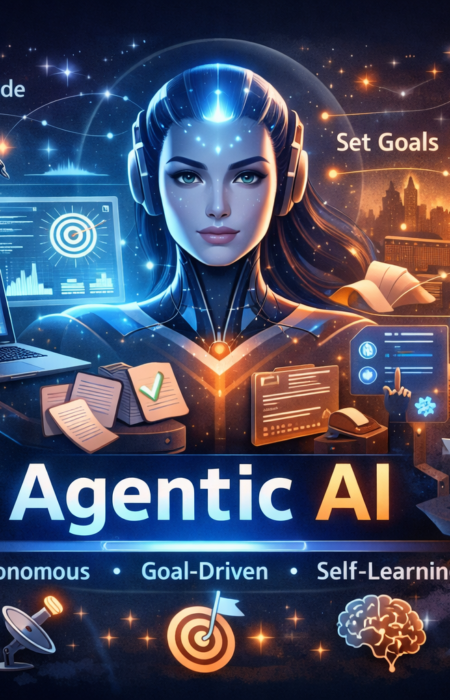




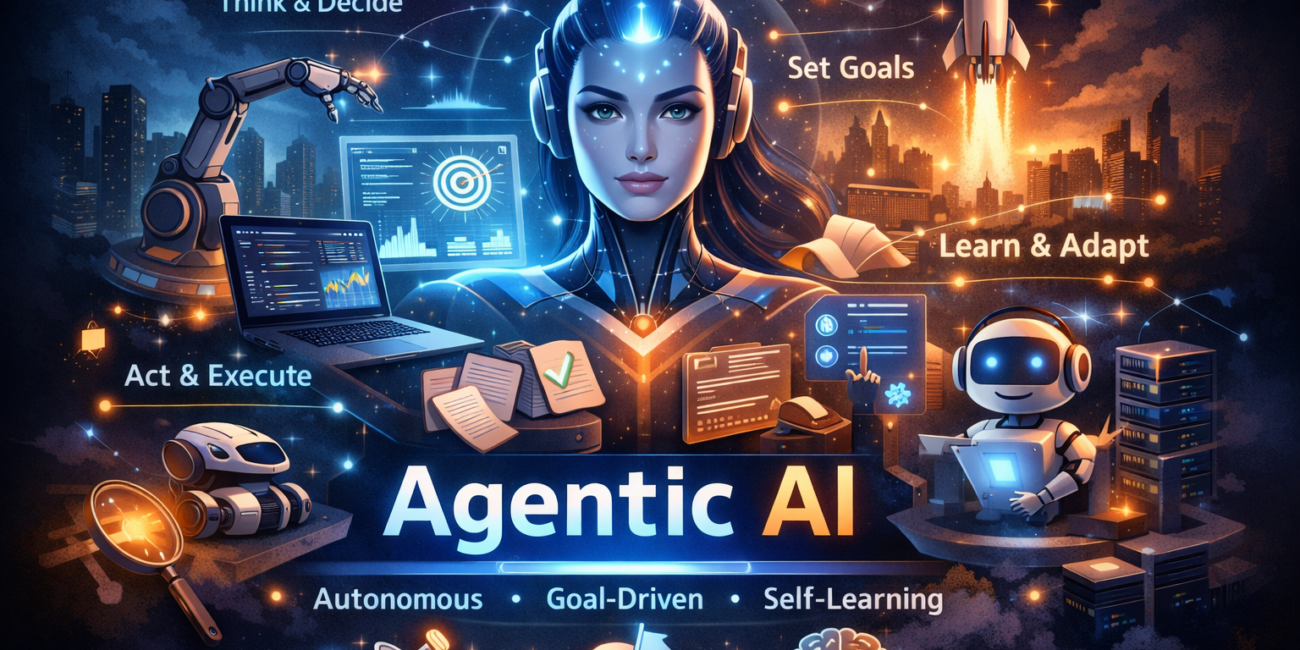
Artificial Intelligence has moved far beyond simple rule-based systems and predictive models. One of the most exciting and transformative developments in this journey is Agentic AI—a form of AI that can act autonomously, set goals, make decisions, and execute tasks with minimal human intervention.
In simple terms, Agentic AI doesn’t just respond to instructions; it takes initiative.
What Is Agentic AI?
Agentic AI refers to AI systems designed as agents—independent entities that can:
- Understand objectives
- Plan steps to achieve those objectives
- Take actions across tools, systems, or environments
- Learn from outcomes and adjust behavior
Unlike traditional AI, which waits for a prompt and delivers an output, Agentic AI can observe → think → decide → act → learn, all in a continuous loop.
How Agentic AI Works
Agentic AI typically operates through a structured cycle:
- Goal Definition
The agent is given (or generates) a goal, such as increasing sales, fixing a bug, or managing customer support. - Planning
It breaks the goal into smaller tasks and decides the best sequence of actions. - Action Execution
The agent uses tools like APIs, databases, web browsers, or software systems to perform tasks. - Observation & Feedback
It monitors results, checks success or failure, and gathers new information. - Learning & Adaptation
Based on outcomes, the agent improves future decisions.
This makes Agentic AI dynamic, context-aware, and self-improving.
Agentic AI vs Traditional AI
| Feature | Traditional AI | Agentic AI |
|---|---|---|
| User Interaction | Prompt → Response | Goal → Autonomous Action |
| Decision Making | Limited | Advanced & continuous |
| Tool Usage | Manual | Automatic |
| Adaptability | Low | High |
| Autonomy | Minimal | Strong |
Real-World Applications of Agentic AI
Business & Operations
- Automating workflows end-to-end
- Managing schedules, reports, and analytics
- Optimizing supply chains
Software Development
- Writing, testing, and debugging code
- Deploying applications
- Monitoring system performance
Customer Support
- Handling tickets autonomously
- Escalating complex issues
- Learning from customer behavior
Marketing & Sales
- Running ad campaigns
- Generating and publishing content
- Analyzing performance and optimizing strategies
Personal Assistants
- Planning travel
- Managing finances
- Coordinating tasks across apps
Benefits of Agentic AI
✅ Higher Productivity – Handles complex tasks without constant supervision
✅ Scalability – Works continuously at machine speed
✅ Cost Efficiency – Reduces human workload
✅ Consistency – Fewer errors caused by fatigue or oversight
✅ Faster Decision-Making – Real-time analysis and action
Challenges & Risks
While powerful, Agentic AI also brings challenges:
Loss of Control – Poorly defined goals can lead to unintended actions
Security Risks – Autonomous access to tools must be well-restricted
Ethical Concerns – Transparency and accountability are critical
Dependence on Data Quality – Bad data leads to bad decisions
Proper guardrails, human oversight, and ethical frameworks are essential.
The Future of Agentic AI
Agentic AI represents a shift from “AI as a tool” to “AI as a collaborator.”
In the future, we can expect:
- Teams of AI agents working together
- Human-AI collaboration at scale
- Businesses running partially or fully autonomously
- Personalized AI agents for individuals and companies
This evolution will redefine how work is done across industries.
Conclusion
Agentic AI is not just another AI trend—it’s a paradigm shift. By enabling machines to think, act, and learn independently, Agentic AI unlocks unprecedented efficiency and innovation. When designed responsibly, it has the potential to become one of the most impactful technologies of the modern era.