





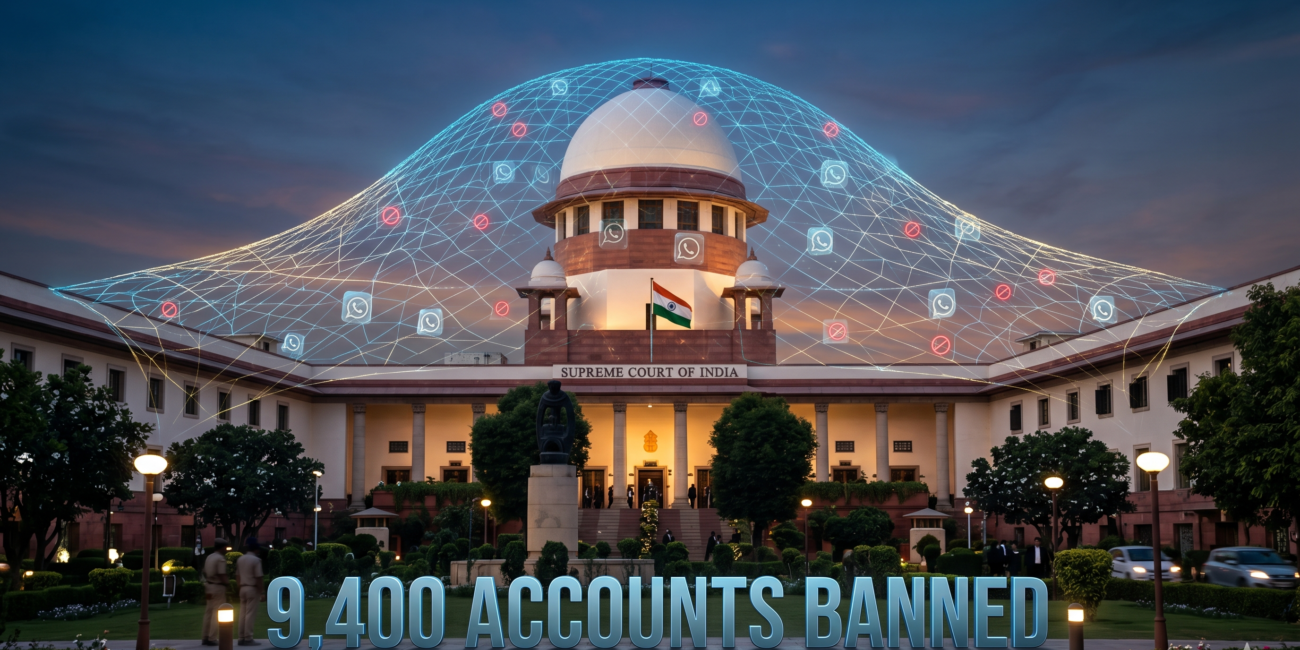
The Digital Siege: WhatsApp Dismantles Massive Fraud Network as Supreme Court Confronts the Crisis of ‘Digital Arrests’
The digital landscape in India has become a primary battleground for a new and terrifying breed of cybercrime known as the “digital arrest.” In a landmark development that underscores the scale of this threat, WhatsApp has disclosed to the Supreme Court of India that it has identified and permanently deactivated over 9,400 accounts linked to these sophisticated extortion syndicates. This massive crackdown, revealed through documents submitted to the Ministry of Home Affairs and presented before the nation’s highest court, marks a pivotal moment in the ongoing struggle to protect citizens from psychological and financial predation. The scale of the operation suggests that these are not merely isolated incidents of fraud but are instead the result of highly organized, international criminal networks operating with surgical precision.
The phenomenon of the digital arrest is a particularly insidious form of cybercrime that leverages fear and the authority of law enforcement to manipulate victims. Fraudsters typically initiate contact through video calls, often dressed in convincing police or investigative uniforms, appearing against backdrops that mimic official government offices. They inform the victim that they are under investigation for serious crimes, such as money laundering, drug trafficking, or the possession of illegal contraband in international parcels. Through a process of intense psychological coercion, the victims are told they are under “digital arrest” and must remain on camera for hours or even days, effectively held hostage in their own homes. The ordeal usually culminates in a demand for massive sums of money, framed as “clearance fees” or “security deposits” to settle the fictional cases.
WhatsApp’s investigative report, which was integrated into a status report filed by the Indian Cybercrime Coordination Centre (I4C), details a proactive strategy to dismantle these operations. The platform explained that it does not treat individual reports of fraud as isolated events. Instead, it uses each report as a “seed” to map out a much larger web of criminality. By analyzing the metadata and communication patterns of flagged accounts, WhatsApp’s security teams were able to “fan out” from the initial point of contact to identify broader networks. This investigative technique allowed the platform to move beyond the foot soldiers and target the administrators and group creators who facilitate the scam on a massive scale. Interestingly, the investigation traced a significant portion of this activity to criminal hubs located in Cambodia, highlighting the transnational nature of the threat.
The financial and emotional toll of these scams is staggering. Data provided by the Ministry of Home Affairs reveals that the government has recorded over 2.41 lakh complaints specifically related to digital arrest frauds. The cumulative financial loss attributed to these scams is estimated at a monumental ₹30,000 crore. This figure, while massive, may only represent the tip of the iceberg, as many victims remain too traumatized or embarrassed to report the crime. The Supreme Court has taken a particularly stern view of the situation, with Chief Justice of India Surya Kant labeling these crimes as among the most “disturbing” and “lethal” forms of cyber offense. The Court emphasized that these are not simple economic crimes but are fundamental violations of human dignity, leaving victims with a deep sense of violation that far outlasts the financial loss.
The judiciary’s intervention was prompted by a series of high-profile cases, including one involving a 78-year-old lawyer who was duped of her life savings. The fact that even a legal professional could be manipulated by the fraudsters speaks to the extreme sophistication of the psychological tactics used. The Supreme Court took suo motu cognisance of the matter in early 2024, recognizing that the existing legal and technical frameworks were struggling to keep pace with the evolving tactics of cyber-extortionists. The Court’s involvement has acted as a catalyst, forcing a more rigorous and coordinated response from both the government and private technology intermediaries.
To combat this rising tide, a multi-agency approach has been adopted. In March, a high-level meeting was convened by the Inter-Departmental Committee, bringing together the Ministry of Home Affairs, the Indian Cybercrime Coordination Centre, and major Telecom Service Providers including Reliance Jio, Airtel, Vodafone-Idea, and BSNL. The focus of these discussions was the implementation of more robust technical safeguards. One of the primary initiatives discussed was “SIM binding,” a process that links a WhatsApp account directly to a physical SIM card and device ID. This measure is intended to make it significantly more difficult for scammers to create and operate bulk accounts using virtual numbers or stolen credentials.
Furthermore, the introduction of The Information Technology (Intermediary Guidelines and Digital Media Ethics Code) Rules, 2021, has placed new obligations on platforms like WhatsApp. These rules specifically address the rise of “Synthetically Generated Information” or SGI. Scammers are increasingly using Artificial Intelligence and Deepfake technology to enhance their impersonations, making their video calls look and sound like legitimate high-ranking officials. WhatsApp has committed to strengthening its AI and Machine Learning systems to detect the misuse of official government logos and the deployment of synthetic media. By identifying these patterns in real-time, the platform aims to issue warnings to users before they fall into the scammers’ trap.
Another critical component of the new strategy is the retention of data. WhatsApp has agreed to preserve the data of deleted or banned accounts for a minimum period of 180 days. This policy shift is crucial for law enforcement agencies, as it provides a window of time for investigators to issue legal requests and obtain evidence that could lead to the identification and prosecution of the individuals behind the screens. Previously, the rapid deletion of accounts by scammers often led to a digital dead-end for investigators. With the new retention policy, there is a greater chance of tracing the money trail and identifying the domestic accomplices who often assist international syndicates in “muling” the stolen funds through local bank accounts.
The battle against digital arrests is also a battle for public awareness. The government and the Supreme Court have both stressed that technological solutions must be accompanied by widespread education. The scammers rely on the victim’s lack of knowledge regarding official legal procedures—specifically the fact that no Indian law enforcement agency or court conducts “arrests” or “investigations” via WhatsApp video calls. The psychological leverage of the scam depends entirely on the victim’s belief in the legitimacy of the digital process. By breaking this illusion through public service announcements and community outreach, the authorities hope to dry up the pool of potential victims.
As the case continues to unfold in the Supreme Court, the focus remains on ensuring that technology companies and the government work in lockstep. The ban of 9,400 accounts is a significant victory, but it is only a single engagement in a much larger war. The fluidity of cybercrime means that as soon as one avenue is closed, syndicates will look for another. The “fan out” probe conducted by WhatsApp demonstrates that a reactive approach is no longer sufficient; instead, a proactive, network-based investigative model is required to stay ahead of criminals who operate without borders.
The legal proceedings have sent a clear message to the digital ecosystem: the era of treating cyber-fraud as a minor nuisance is over. With tens of thousands of crores at stake and the psychological well-being of the elderly and vulnerable under threat, the crackdown on digital arrest syndicates has become a national security priority. The collaboration between the Ministry of Home Affairs, the judiciary, and global tech giants like WhatsApp represents a new blueprint for tackling the complexities of the digital age, ensuring that the tools meant for global connection are not permanently hijacked by those seeking to cause harm.