



The Silicon Pivot: How Google’s Custom Hardware is Redefining the AI Superpower Era
The technology world has long viewed Google through the lens of a single, dominant utility: the search engine. For over two decades, the company’s identity was inseparable from the white homepage and the algorithm that indexed the world’s information. However, a profound transformation is currently underway within the corridors of Mountain View, one that suggests Google has fundamentally outgrown its original purpose. While the public and the financial press were preoccupied with the sudden rise of conversational AI and the perceived threat to Google’s search monopoly, the company was quietly finalizing a decade-long transition. Google is no longer just a search company; it has evolved into a vertically integrated, full-stack artificial intelligence powerhouse that owns the means of production from the silicon chips upward.
The narrative of the last two years has often focused on Google’s supposed vulnerability. When OpenAI released ChatGPT in late 2022, the tech industry entered what many called a “Code Red” moment for Google. The rapid adoption of large language models suggested that the traditional search bar might soon become an artifact of the past, replaced by intuitive, conversational interfaces. To the outside world, Google appeared to be scrambling, rushing to release Bard and later Gemini to prove it had not lost its innovative edge. Yet, as CEO Sundar Pichai recently reflected, this period was less about a panic and more about a shift in the public’s readiness to interact with the technologies Google had been developing in secret for years. The company wasn’t caught sleeping; it was waiting for the “Overton window” of public perception to move toward the AI-first future it had envisioned as early as 2016.
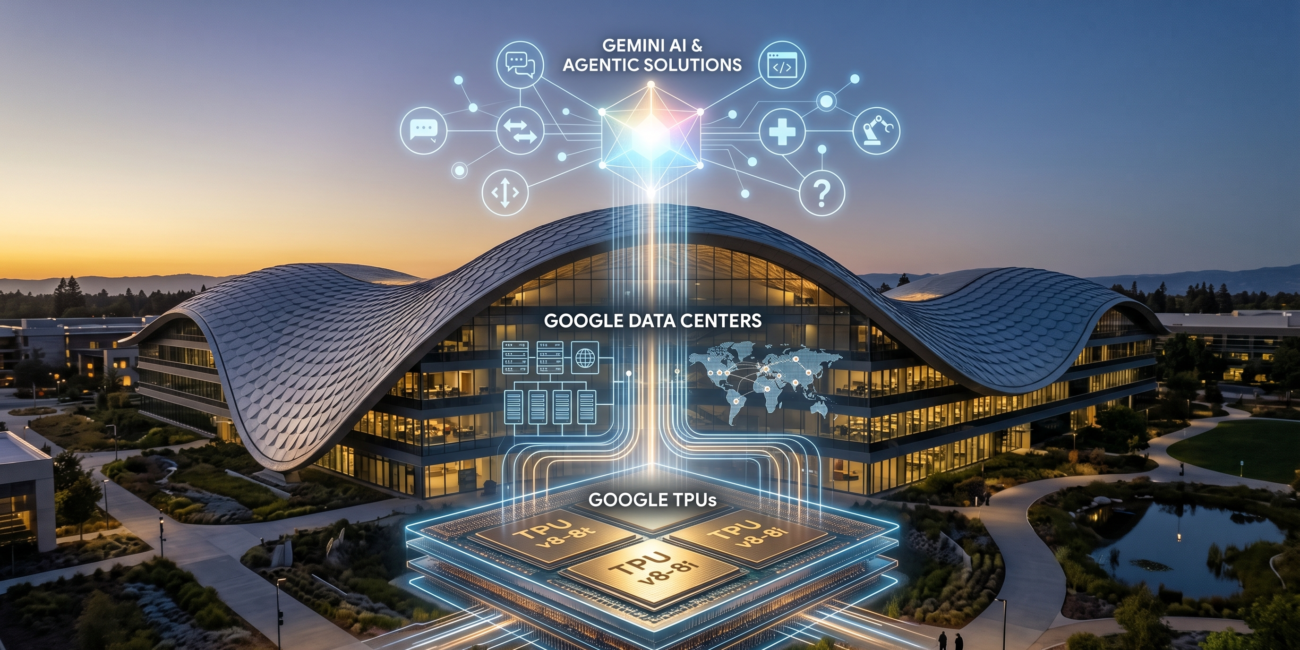
The true cornerstone of this new identity is not a software product, but a piece of hardware known as the Tensor Processing Unit, or TPU. While the rest of the technology sector found itself embroiled in a desperate and expensive scramble to secure Nvidia’s H100 graphics processing units, Google was already operating on its seventh and eighth generations of custom-built AI silicon. This distinction is critical to understanding the modern tech landscape. Most AI companies are currently building on “rented land,” relying on third-party hardware that is both scarce and prohibitively expensive. Google, by contrast, owns the foundation. By designing its own chips specifically for the mathematical workloads required by neural networks, Google has achieved a level of efficiency and vertical integration that few other companies on earth can match.
To understand why this matters, one must look at the two distinct phases of artificial intelligence: training and inference. Training is the process of feeding an AI model massive amounts of data so it can learn patterns, a process that requires raw, immense computational power. Inference is the stage where the model actually answers a user’s question in real-time. While Nvidia’s general-purpose chips are the undisputed kings of training, Google’s TPUs are increasingly seen as a superior weapon for inference. As AI moves from a novelty to a global utility used by billions of people simultaneously, the cost and speed of inference will determine the winners of the industry. Google’s ability to run its Gemini models on its own TPUs within its own data centers allows it to deliver AI responses at a scale and price point that its competitors struggle to achieve.
The impact of Google’s silicon strategy became undeniable when reports surfaced that Meta, a primary consumer of Nvidia’s hardware, had begun diversifying its infrastructure to include Google’s TPUs. This sent a shockwave through the stock market, wiping billions from Nvidia’s valuation in a single day and signaling that the semiconductor giant’s monopoly was not as secure as once thought. Google is no longer just using its chips to power its own search results; it is now a major merchant of AI compute. Through Google Cloud, the company is renting out its specialized silicon to startups, researchers, and even rival tech firms. This shift transforms Google from a service provider into an essential infrastructure layer for the entire global AI economy.
The latest iteration of this strategy is the introduction of the TPU v8, which marks a significant fork in the company’s hardware roadmap. By splitting the v8 generation into two specialized configurations—the 8t for massive-scale training and the 8i for high-performance inference—Google is addressing the dual needs of the “agentic” era. We are entering a phase where AI is expected to be more than a chatbot; it must be an agent capable of planning multi-step tasks, interacting with external software, and making decisions in real-time. These “agentic” workloads require near-zero latency, a feat that is only possible when the hardware is purpose-built for the task. The TPU 8i is designed specifically for this future, ensuring that as AI becomes more autonomous, Google remains the platform of choice for running those agents.
This vertical integration represents a strategic “moat” that is far wider than the one provided by a search algorithm. By controlling the research, the models, the data centers, and the silicon, Google has created a closed loop of innovation. When Google’s researchers develop a new AI architecture, their hardware engineers can immediately optimize the next generation of TPUs to run that specific architecture more efficiently. This synergy creates a compounding advantage that is difficult for companies focused solely on software or solely on hardware to replicate. It is a full-stack approach that mirrors how Apple dominated the smartphone market, but applied to the most transformative technology of the twenty-first century.
Furthermore, the evolution of Google’s cloud business highlights the company’s new priorities. Google Cloud has become one of the fastest-growing segments of the company, fueled largely by the demand for AI-specific infrastructure. For many enterprises, the choice is no longer just about which cloud provider has the most storage, but which one can provide the fastest and most cost-effective path to deploying AI at scale. By offering the TPU as a unique value proposition, Google has successfully positioned its cloud business as a specialized alternative to Amazon Web Services and Microsoft Azure.
Sundar Pichai’s assertion that the company was “built for this moment” reflects a long-term bet that is finally paying off. While the media narrative focused on a “race” between chatbots, Google was playing a much longer game focused on the fundamental physics of computing. The company recognized early on that the sheer volume of data and the complexity of the models would eventually outstrip the capabilities of general-purpose hardware. Their investment in custom silicon, which began nearly a decade ago when the term “LLM” was unknown to the public, was a gamble that has now become their greatest competitive asset.
As we look toward the future, the term “search company” feels increasingly inadequate to describe Google’s role in the world. While search remains a vital part of its revenue and its primary touchpoint with consumers, it is now just one application running on top of a massive, AI-first infrastructure. Google is now a semiconductor designer, a cloud infrastructure titan, and a frontier research lab, all rolled into one. The transition from a company that helps you find information to a company that provides the intelligence and the hardware to process that information is complete.
In conclusion, the “Code Red” of 2022 was not the end of Google, but rather the catalyst that forced the company to reveal its true form. By stepping out from behind the search bar and showcasing its deep integration in the world of custom silicon and agentic AI, Google has redefined what it means to be a technology leader in the twenty-first century. The battle for AI dominance will not be won just with clever prompts or creative chatbots; it will be won in the data centers and the silicon foundries. With its seventh and eighth generations of TPUs now coming online, Google has demonstrated that it is prepared to lead that battle from the ground up, proving that while the world was watching the search results, Google was building the future of computing itself.