





Artemis II Moon Flyby: Historic Images and the Growing Role of Artificial Intelligence in Deep Space Exploration
Introduction
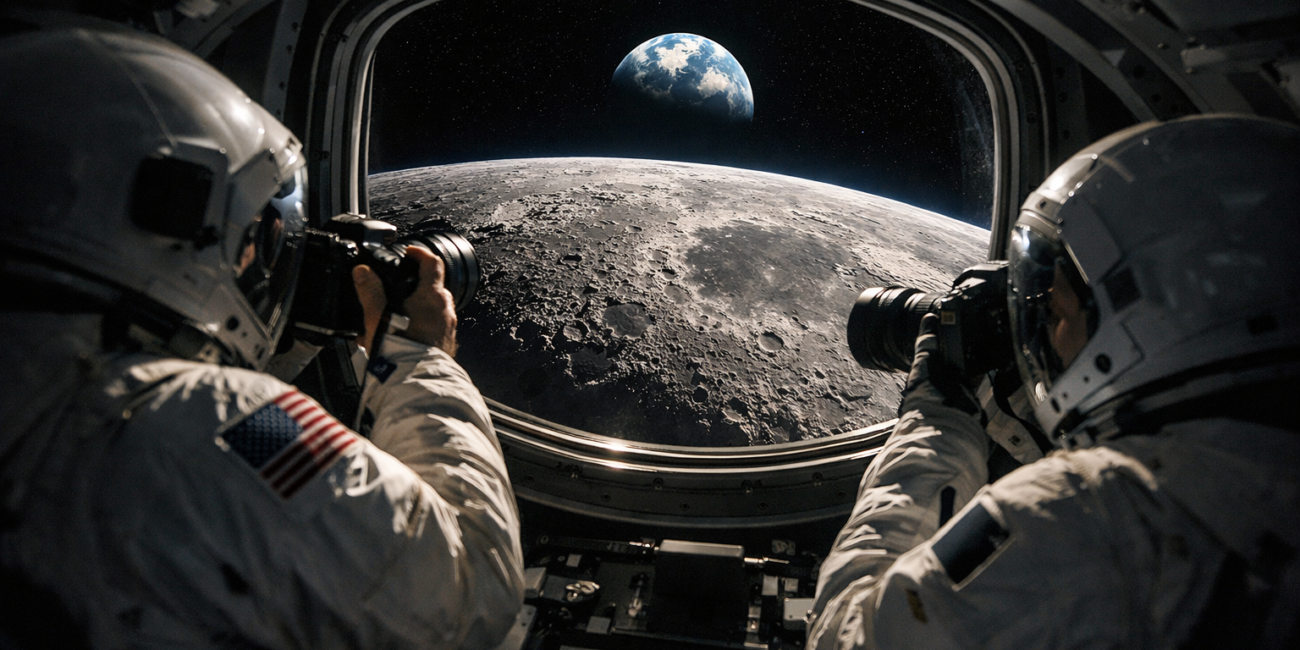
NASA’s Artemis II mission represents one of the most important milestones in modern space exploration. For the first time in more than fifty years, astronauts traveled beyond low Earth orbit and flew around the Moon, capturing breathtaking images of the lunar far side and Earth from deep space. These photographs symbolize humanity’s return to lunar exploration, but they also represent something equally significant: the evolution of space missions into intelligent, AI-assisted operations.
The Artemis II mission combined human expertise with advanced computing, automation, and artificial intelligence. While astronauts remained at the center of decision-making, AI systems quietly supported navigation, communication, imaging, and spacecraft health monitoring. The result was a mission that demonstrated how humans and intelligent systems can work together to expand exploration beyond Earth.
This article explores the Artemis II Moon flyby, the importance of the images transmitted to Earth, and the crucial role artificial intelligence played in enabling the mission.
The Artemis Program and Its Goals
The Artemis program is NASA’s long-term initiative to return humans to the Moon and create a sustainable presence on and around it. Unlike the Apollo missions, which focused on short-term exploration, Artemis is designed for long-term operations, infrastructure development, and preparation for missions to Mars.
The program consists of multiple missions. Artemis I tested the Orion spacecraft without a crew. Artemis II carried astronauts on a lunar flyby. Artemis III is planned to land humans on the Moon. Later missions aim to build lunar stations, deploy surface habitats, and expand scientific exploration.
Artemis II was especially important because it was the first crewed mission in the program. It tested life-support systems, crew operations, deep-space navigation, and communication technologies. The mission also allowed astronauts to capture new images of the Moon from a human perspective, something not done since the Apollo era.
The Artemis II Lunar Flyby
During the mission, the Orion spacecraft traveled thousands of kilometers beyond the Moon and performed a flyby trajectory. This path took the spacecraft around the far side of the Moon, a region that is never visible from Earth. While passing behind the Moon, communication with Earth temporarily stopped, creating a critical test of autonomous systems.
The crew captured high-resolution images of the lunar surface during this period. These images showed massive craters, rugged mountains, shadowed valleys, and the dramatic contrast between sunlit and dark regions. Some photographs also showed Earth appearing above the lunar horizon, recreating the iconic Earthrise perspective with modern imaging technology.
After Orion emerged from behind the Moon, the stored images were transmitted back to Earth. The successful transmission demonstrated that Orion’s communication and onboard data handling systems worked correctly in deep space.
Importance of the Moon Flyby Images
The Artemis II photographs are historically significant. They represent the first human-captured deep-space lunar images in decades. Beyond symbolism, these images provide valuable scientific and operational data.
The images help engineers verify spacecraft orientation and camera alignment. They also confirm lighting conditions during lunar flyby operations. This information is essential for planning future landing missions where visibility and surface detail matter.
Scientists also benefit from updated views of the Moon’s far side. This region differs geologically from the near side and contains many unexplored features. High-resolution images improve mapping, terrain analysis, and landing site evaluation.
Public engagement is another important factor. Human-captured images from deep space create excitement and inspire new generations to pursue science, technology, and engineering careers. The Artemis II images help demonstrate that humanity is once again exploring beyond Earth orbit.
The Orion Spacecraft
The Orion spacecraft is designed specifically for deep-space missions. Unlike spacecraft that operate only in Earth orbit, Orion can travel to the Moon and beyond. It includes advanced life-support systems, radiation protection, autonomous navigation, and high-bandwidth communication technology.
Orion also carries sophisticated imaging equipment. These cameras capture high-resolution still images and video of the Moon, Earth, and deep space. During Artemis II, these systems were used extensively during the lunar flyby.
The spacecraft includes onboard computing systems capable of processing large amounts of data. Artificial intelligence and machine learning software assist in managing this information, allowing Orion to operate efficiently even when communication with Earth is temporarily unavailable.
Artificial Intelligence in Modern Space Missions
Artificial intelligence has become increasingly important in space exploration. Deep-space missions involve long distances, communication delays, and complex operations. AI helps automate routine tasks, detect anomalies, and support decision-making.
In Artemis II, AI was used as a support tool rather than a replacement for human control. Astronauts and mission control remained responsible for major decisions. AI systems assisted by analyzing data, identifying patterns, and optimizing operations.
This collaborative model is expected to become standard for future missions, including lunar landings and Mars exploration.
AI in Image Processing
One of the most important AI roles in Artemis II involved managing the images captured during the lunar flyby. The spacecraft collected a large number of photographs. However, deep-space communication bandwidth is limited. Not all images can be transmitted immediately.
AI-assisted software helped evaluate image quality and identify the most valuable frames. The system analyzed sharpness, exposure, and content. It also removed redundant images and prioritized those with scientific or operational importance.
This process ensured that the best images were transmitted first once communication with Earth resumed. AI also assisted with image compression, reducing file size while preserving important detail.
AI-Assisted Navigation
Navigation around the Moon requires precise positioning. Orion used star trackers and optical navigation cameras to determine spacecraft orientation. AI algorithms analyzed images of stars and lunar landmarks to verify position.
These systems compared real-time images with onboard maps. The AI helped confirm that the spacecraft followed the planned trajectory. If deviations were detected, mission control and astronauts received updated information.
This type of navigation support reduces reliance on constant Earth-based tracking. It also increases spacecraft autonomy, which will be essential for future deep-space missions.
AI for Spacecraft Health Monitoring
The Orion spacecraft contains thousands of sensors monitoring temperature, pressure, electrical systems, and propulsion performance. AI-based anomaly detection software analyzed this data continuously.
The system looked for unusual patterns that might indicate potential problems. For example, unexpected temperature changes or power fluctuations could trigger alerts. Early detection allows astronauts and mission control to respond quickly.
This predictive capability improves safety and reduces the risk of system failures during long missions.
AI in Communication Optimization
Communication between Orion and Earth is limited by distance and signal strength. During Artemis II, AI helped manage data transmission efficiently.
The system prioritized critical information, including navigation data and key images. It scheduled transmissions based on available communication windows. AI also adjusted compression levels to maximize bandwidth use.
These capabilities are especially important for future Mars missions, where communication delays can exceed twenty minutes.
AI-Assisted Crew Support
AI also supported astronauts directly. Digital assistant software helped manage mission timelines and procedures. These systems tracked tasks, highlighted upcoming operations, and displayed system status summaries.
This reduces crew workload and helps astronauts focus on complex activities. AI assistants can also adapt schedules if delays occur, improving mission flexibility.
Comparison with Apollo Missions
The Artemis II mission highlights how space technology has evolved since Apollo. Apollo missions relied on limited computing power and manual calculations. Astronauts performed many navigation and operational tasks manually.
Artemis II benefits from modern computing and AI. Navigation is more precise. Communication is more efficient. Imaging systems are more advanced. Automation reduces crew workload.
Despite these advancements, the human role remains central. Astronauts still make final decisions and handle unexpected situations.
Preparing for Future Lunar Missions
Artemis II serves as a rehearsal for future missions. The data collected during the flyby helps validate systems needed for lunar landing. Engineers analyze navigation accuracy, communication performance, and imaging results.
Artificial intelligence will play an even larger role in future missions. Autonomous landing systems will use AI to detect hazards and select safe landing sites. Surface rovers will use AI to explore independently. Predictive maintenance systems will monitor spacecraft health.
These capabilities will support long-duration missions and sustained lunar presence.
Human and AI Collaboration
The Artemis II mission demonstrates a partnership between humans and intelligent systems. Humans provide creativity, adaptability, and judgment. AI provides speed, automation, and data analysis.
Together, they create more capable missions. This collaboration will be essential for deep-space exploration where communication delays limit Earth-based support.
Conclusion
The Artemis II Moon flyby marks a historic return to deep space. The images captured by astronauts provide inspiration and valuable scientific data. At the same time, artificial intelligence played a critical supporting role behind the scenes.
AI assisted with image processing, navigation, communication, spacecraft monitoring, and crew support. These technologies helped ensure mission success and demonstrated the future of human space exploration.
As NASA prepares for lunar landings and eventual missions to Mars, AI will become even more important. Artemis II shows that the future of exploration will be built on collaboration between astronauts and intelligent systems, opening a new chapter in humanity’s journey beyond Earth.