




Introduction: Meta’s Shift Toward Personal Superintelligence
The launch of Muse Spark by Meta Platforms represents one of the most important developments in artificial intelligence in recent years. Rather than simply building larger models or improving benchmark performance, Meta is introducing a fundamentally different concept: personal superintelligence. This idea focuses on creating AI systems that understand individuals, interpret their environment, and assist in everyday decisions rather than only responding to text prompts.
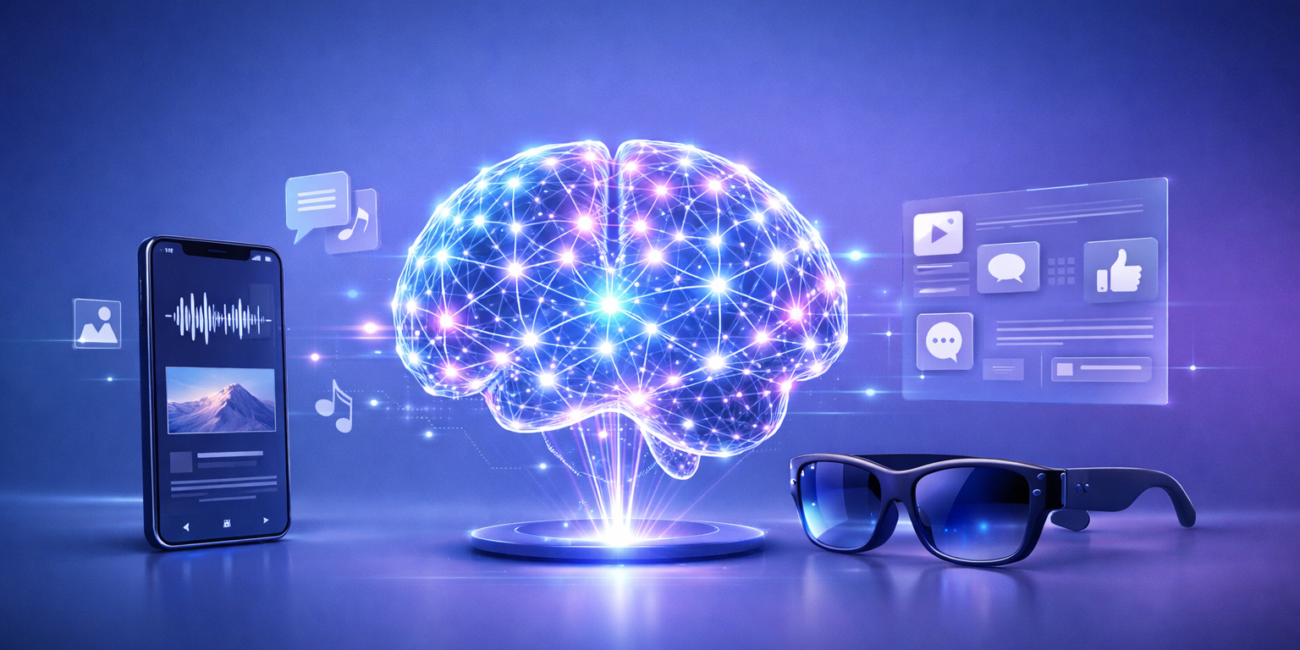
Muse Spark is the first model released by Meta Superintelligence Labs, a new research initiative dedicated to developing next-generation AI systems. The model is designed to combine multimodal understanding, advanced reasoning, and agent-based task execution into a single unified architecture. The result is an AI system that is intended to function less like a chatbot and more like an intelligent assistant embedded into daily life.
This shift signals a broader transformation in how AI is being built. Instead of designing models that operate primarily through conversation, Meta is working toward AI that can see, understand, and act. Muse Spark represents an early step in this direction, but its architecture and goals reveal the long-term ambition: AI that becomes a personal intelligence layer for billions of users.
What Is Muse Spark?
Muse Spark is a multimodal reasoning model designed to process text, images, and audio together. Unlike traditional AI systems that convert all inputs into text before reasoning, Muse Spark integrates multiple data types directly into its reasoning process. This allows the system to interpret real-world situations more naturally.
For example, a user can show the AI an image of food items and ask which one is healthier. Instead of only identifying the objects, Muse Spark can analyze labels, compare nutritional values, and provide contextual recommendations. This capability demonstrates how the model moves beyond simple description toward decision-making.
The model is also built with efficiency in mind. Meta emphasizes that Muse Spark is optimized to deliver strong reasoning performance while using fewer computational resources. This efficiency is crucial for deploying AI across platforms such as messaging apps, social networks, and wearable devices. The goal is to make AI assistance immediate and accessible rather than requiring heavy cloud processing.
Native Multimodal Architecture
One of the most important features of Muse Spark is its native multimodal architecture. Many earlier AI models were trained primarily on text and later extended to handle images or audio. This often resulted in fragmented reasoning, where the model treated each modality separately. Muse Spark is designed differently. It processes multiple modalities together from the start.
This architecture allows the model to analyze visual scenes, interpret charts, and understand real-world environments. For instance, Muse Spark can look at a graph and explain trends, examine a document and summarize key points, or analyze a photo and provide recommendations. These capabilities are essential for practical AI applications, where information is often presented visually.
The integration of multimodal reasoning also enables more natural interaction. Users no longer need to describe everything in words. Instead, they can show the AI what they are looking at. This reduces friction and makes AI more intuitive. Over time, this approach could transform how people interact with technology.
Multi-Agent Reasoning and Task Orchestration
Another defining characteristic of Muse Spark is its multi-agent reasoning system. Rather than handling a task as a single process, the model can divide the task into multiple subtasks handled by internal agents. Each agent focuses on a specific aspect of the problem, and the results are combined into a final response.
For example, when planning a trip, one agent might search for destinations, another might compare prices, and a third might create an itinerary. These agents operate simultaneously, allowing the system to reason more effectively. This architecture mirrors human problem-solving strategies, where complex decisions are broken into manageable steps.
The multi-agent approach also improves scalability. By distributing reasoning across multiple processes, Muse Spark can handle more complex tasks without dramatically increasing computational requirements. This makes it suitable for real-world use cases that involve planning, analysis, and decision-making.
Visual Reasoning Capabilities
Muse Spark’s visual reasoning capabilities extend beyond simple image recognition. The model can analyze relationships within images and draw conclusions based on context. For instance, it can compare products, interpret diagrams, and evaluate visual data.
This capability is particularly useful in areas such as education, productivity, and research. Students can use the AI to understand diagrams, professionals can analyze charts, and users can evaluate options visually. The ability to reason visually brings AI closer to human-like understanding.
Visual reasoning also plays a key role in Meta’s vision of personal superintelligence. If AI can interpret the user’s environment, it can provide more relevant assistance. For example, the system might identify objects, suggest actions, or provide contextual information. This transforms AI from a passive tool into an active helper.
Built-In Tool Use and External Integration
Muse Spark is designed to interact with external tools such as search engines, calculators, and software interfaces. This allows the model to extend its capabilities beyond static knowledge. By using tools, the AI can access up-to-date information and perform complex operations.
This integration is essential for real-world applications. For example, the AI might retrieve current data, perform calculations, or generate structured outputs. Tool use enables dynamic responses rather than relying solely on training data.
The ability to use tools also supports the multi-agent architecture. Different agents can call different tools, allowing the system to handle complex workflows. This makes Muse Spark more versatile and capable of handling diverse tasks.
Efficiency and Deployment at Scale
Efficiency is a central theme in Muse Spark’s design. Meta emphasizes that the model is optimized for speed and responsiveness. This is achieved through architectural optimizations and training techniques that reduce computational overhead.
The emphasis on efficiency reflects Meta’s deployment strategy. The company plans to integrate AI into its ecosystem, including messaging platforms and wearable devices. For these applications, AI must respond quickly and operate within resource constraints. Muse Spark is built to meet these requirements.
This approach contrasts with models that prioritize scale above all else. Instead of simply increasing parameters, Meta is focusing on practical performance. The result is a model that balances capability and efficiency.
The Concept of Personal Superintelligence
Personal superintelligence is the core idea behind Muse Spark. Instead of creating a single AI that serves everyone identically, Meta is building systems that adapt to individuals. Over time, the AI can learn preferences, habits, and contexts.
This personalization allows the AI to provide proactive assistance. For example, it might suggest healthier food choices, help plan travel, or organize tasks. The system becomes more useful as it understands the user better.
This vision represents a shift from reactive AI to proactive AI. Instead of waiting for prompts, the system anticipates needs. This transformation could redefine how people interact with technology.
Competitive Landscape and Industry Context
The release of Muse Spark occurs within a competitive AI landscape. Companies such as OpenAI, Google DeepMind, and Anthropic are developing their own multimodal and reasoning models. Each company emphasizes different priorities.
Meta differentiates itself by focusing on personal integration. Rather than optimizing solely for benchmarks, Muse Spark aims to enhance daily experiences. This strategy aligns with Meta’s ecosystem-driven business model.
The competition among these companies is accelerating innovation. As models become more capable, the emphasis is shifting toward usability and real-world impact. Muse Spark reflects this trend.
Use Cases and Applications
Muse Spark has a wide range of potential applications. In productivity, it can summarize documents, generate content, and assist with planning. In education, it can explain concepts using visual reasoning. In lifestyle scenarios, it can analyze food, compare products, and provide recommendations.
These applications demonstrate how multimodal AI can enhance everyday tasks. Instead of using separate tools, users can rely on a single intelligent assistant. This simplifies workflows and improves efficiency.
The model’s versatility also opens possibilities for new applications. Developers could build tools that leverage multimodal reasoning. Businesses could integrate AI into customer experiences. The potential impact extends across industries.
Privacy, Trust, and User Control
Personal superintelligence requires access to contextual information. This raises important questions about privacy and trust. Users must feel confident that their data is handled responsibly.
Meta will need to address these concerns through transparency and user controls. The success of Muse Spark depends on building trust. If users believe the AI respects their privacy, adoption is more likely.
Balancing personalization and privacy will be a key challenge. The design of safeguards and controls will shape the future of personal AI.
The Future of Muse Spark and Meta AI
Muse Spark represents the beginning of a broader roadmap. Meta is expected to release larger models and expand capabilities. Over time, the system may become more advanced and deeply integrated into devices.
The long-term vision includes AI embedded in wearable technology, messaging platforms, and social experiences. This integration would bring intelligence closer to everyday life.
As the technology evolves, Muse Spark could become a foundational layer for Meta’s AI ecosystem. The concept of personal superintelligence may define the next generation of AI.
Conclusion
Muse Spark marks a significant step toward a new paradigm in artificial intelligence. By combining multimodal reasoning, multi-agent architecture, and personalization, Meta is pursuing a vision of AI that is deeply integrated into human life. The model moves beyond traditional chatbots and toward proactive assistance.
The success of this vision will depend on execution, trust, and continued innovation. However, Muse Spark clearly signals Meta’s direction. The company is betting that the future of AI is personal, contextual, and embedded in everyday experiences. If this vision becomes reality, Muse Spark may be remembered as the starting point of personal superintelligence.