



Nvidia CEO Jensen Huang Calls Taiwan the ‘Epicentre’ of the AI Revolution as Company Plans Massive Expansion
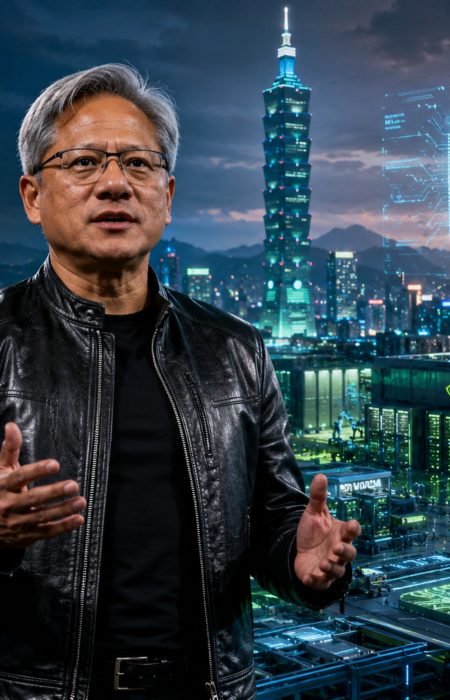
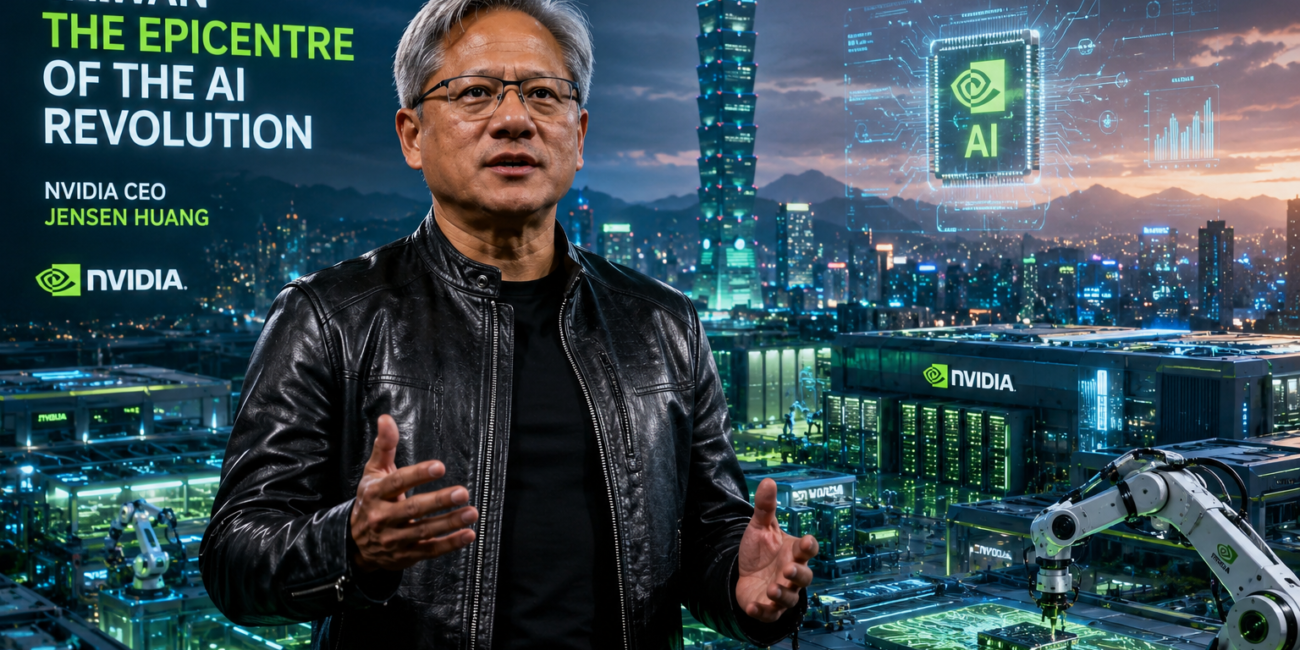
The global artificial intelligence race is accelerating faster than ever, and according to Nvidia CEO Jensen Huang, the center of this transformation is no longer Silicon Valley alone. Speaking during his recent visit to Taiwan, Huang described the island as the “epicentre of the AI revolution,” highlighting its critical role in powering the next generation of artificial intelligence technologies.
His statement comes at a time when Nvidia is rapidly expanding its global AI footprint and strengthening its relationship with Taiwan’s semiconductor and hardware ecosystem. Reports indicate that Nvidia’s annual spending connected to Taiwan’s supply chain could rise to nearly $150 billion in the coming years, signaling one of the most significant technology expansion efforts in the AI era.
The announcement has immediately attracted attention across financial markets, the semiconductor industry, and the global technology sector. Analysts believe Nvidia’s growing dependence on Taiwan reflects not only the company’s dominance in AI chips but also Taiwan’s unmatched importance in the global semiconductor supply chain.
Taiwan’s Role in the AI Boom Continues to Grow
For years, Taiwan has played a vital role in the global technology industry, especially through semiconductor manufacturing. However, the explosive rise of artificial intelligence has pushed the island into an even more strategic position.
Companies around the world are racing to build AI infrastructure capable of supporting advanced models, cloud computing systems, robotics, autonomous technologies, and data centers. At the center of that infrastructure are high-performance AI chips, and Nvidia currently dominates this market.
Most of Nvidia’s advanced chips are manufactured through Taiwan-based partners, particularly Taiwan Semiconductor Manufacturing Company, widely known as TSMC. The company is considered the world’s leading semiconductor foundry and produces some of the most advanced chips ever created.
Taiwan is also home to major electronics manufacturers including Foxconn, Quanta Computer, and Wistron, all of which contribute to Nvidia’s expanding AI ecosystem.
As AI demand continues to surge globally, Taiwan’s importance is growing from a manufacturing hub into the core foundation of the AI economy itself.
Jensen Huang’s Vision for the Future of AI
During his remarks, Jensen Huang emphasized that artificial intelligence is entering a completely new phase. According to him, the world is moving toward an era where AI factories, advanced computing systems, and accelerated processing will reshape industries ranging from healthcare and finance to transportation and entertainment.
Huang praised Taiwan’s engineering capabilities, manufacturing expertise, and technological ecosystem, stating that the region has become essential for the future of AI development.
The Nvidia CEO also revealed plans for a new headquarters project in Taiwan. Reports suggest construction could begin in 2026, while operations may officially start by 2030. The move is seen as a long-term commitment to strengthening Nvidia’s partnership with Taiwan-based suppliers and manufacturers.
Industry experts believe the expansion will allow Nvidia to further secure its production capacity as demand for AI hardware continues to increase worldwide.
Nvidia’s Massive Spending Signals Long-Term Commitment
One of the most talked-about aspects of the announcement is Nvidia’s reported spending target connected to Taiwan.
According to recent reports, Nvidia’s annual business activity related to Taiwan’s supply chain has grown dramatically over the past few years. What was once estimated at around $10 billion to $15 billion annually has reportedly surged close to $100 billion, with expectations that it could eventually reach $150 billion per year.
While some online discussions initially misunderstood the figure as a direct investment into physical infrastructure, analysts clarified that the amount largely reflects Nvidia’s broader supply chain spending, manufacturing operations, component sourcing, and production partnerships within Taiwan.
Even so, the number highlights the enormous scale of Nvidia’s AI business and the increasing importance of Taiwan to the company’s future.
The expansion also demonstrates how rapidly the AI industry is evolving. Companies are no longer investing millions into AI infrastructure; they are investing hundreds of billions in order to stay competitive in the next generation of computing.
Why Taiwan Matters More Than Ever
Taiwan’s strategic importance has become one of the most critical discussions in the technology industry.
Modern AI systems require incredibly powerful chips that can process massive amounts of data efficiently. Producing these chips demands cutting-edge manufacturing facilities, highly specialized engineering talent, and advanced supply chain coordination. Taiwan currently leads the world in several of these areas.
TSMC alone manufactures chips for many of the world’s biggest technology companies, including Nvidia, Apple, AMD, and Qualcomm. Without Taiwan’s semiconductor industry, the global AI race would likely slow down significantly.
This growing dependence has also increased geopolitical concerns. Tensions between China and Taiwan remain one of the biggest risks facing the global technology sector. Many analysts warn that any disruption involving Taiwan could severely impact semiconductor production and the worldwide AI supply chain.
Despite these concerns, Nvidia appears fully committed to deepening its relationship with Taiwan. Huang’s public praise of Taiwan’s role in the AI revolution sends a strong message about how essential the region has become to the future of artificial intelligence.
Global Markets React to Nvidia’s Expansion Plans
The announcement quickly generated strong reactions across financial markets and technology communities.
Investors continue to view Nvidia as one of the biggest winners of the AI boom. The company has already experienced extraordinary growth due to rising demand for AI GPUs, data center hardware, and accelerated computing systems.
Analysts believe Nvidia’s aggressive expansion in Taiwan could further strengthen its dominance in the AI industry. By securing manufacturing partnerships and long-term supply chain stability, Nvidia may gain an even larger advantage over competitors in the coming years.
Technology enthusiasts and investors online also discussed the broader implications of Huang’s comments. Many described Taiwan as the true backbone of the global technology economy, while others raised concerns about how concentrated the semiconductor industry has become in one region.
The conversation reflects a growing realization that artificial intelligence is no longer just a software story. It is now deeply connected to physical infrastructure, semiconductor manufacturing, energy systems, and global supply chains.
The Future of AI Infrastructure Is Being Built Now
Nvidia’s latest expansion efforts show that the AI revolution is moving into a new stage focused on infrastructure at an unprecedented scale.
As companies compete to develop more advanced AI models, demand for processing power continues to explode. Governments, cloud providers, startups, and enterprise businesses are all investing heavily in AI data centers capable of training and running increasingly complex systems.
This demand is pushing semiconductor manufacturers to their limits, making Taiwan one of the most important regions in the global economy.
Jensen Huang’s comments about Taiwan being the “epicentre” of the AI revolution may sound bold, but many industry experts believe the statement accurately reflects today’s technological reality. Taiwan is no longer simply a manufacturing destination; it has become the foundation upon which much of the modern AI industry is being built.
For Nvidia, the company’s future growth appears closely tied to Taiwan’s semiconductor leadership. As AI adoption spreads across industries and countries, Nvidia’s partnership with Taiwan could become even more valuable in the years ahead.
The AI race is only beginning, and the infrastructure powering that future is already taking shape. At the center of it all stands Taiwan, now recognized by Nvidia’s CEO as the driving force behind one of the biggest technological revolutions in modern history.