




NVIDIA Signals a New Era in AI as It Doubles Down on Infrastructure and Trillion-Dollar Growth Vision
Introduction
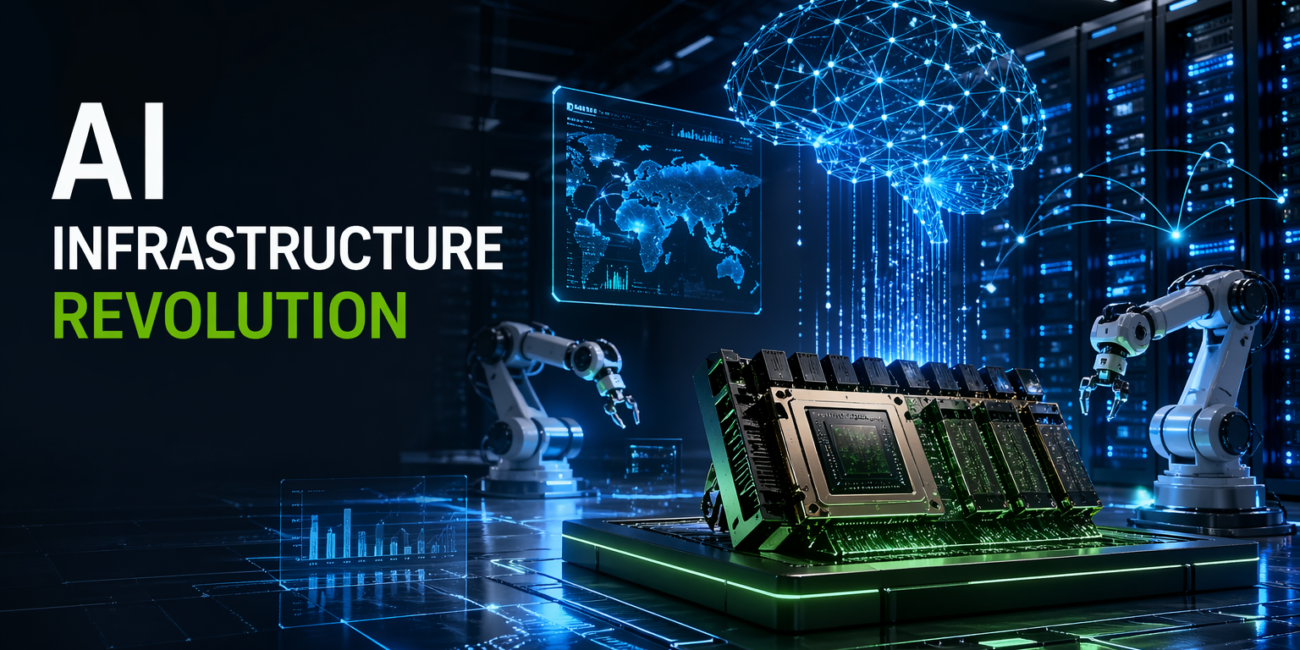
The global artificial intelligence race is entering a decisive phase, and NVIDIA has positioned itself firmly at the center of this transformation. Once known primarily for its dominance in graphics processing units (GPUs), the company is now redefining its identity as a full-scale AI infrastructure leader. Recent developments, including its renewed focus on strategic partnerships and its bold projection of a trillion-dollar AI market, highlight a major shift not only in NVIDIA’s business strategy but also in the broader direction of the technology industry.
These moves indicate that AI is no longer a niche innovation confined to research labs or experimental applications. Instead, it is rapidly becoming a foundational layer of modern economies, influencing industries ranging from healthcare and manufacturing to finance and telecommunications. NVIDIA’s evolving role suggests that the future of AI will be built not just on algorithms, but on the infrastructure that powers them.
A Strategic Pivot Beyond GPUs
For years, NVIDIA’s success has been closely tied to its ability to produce high-performance chips capable of handling complex computational tasks. However, the company’s latest direction reveals a deeper ambition. NVIDIA is no longer content with being a hardware supplier; it is actively transforming into a provider of comprehensive AI infrastructure solutions.
This shift involves expanding its capabilities beyond GPUs to include networking technologies, data center architectures, and software ecosystems that support large-scale AI operations. By doing so, NVIDIA is positioning itself as an essential partner for organizations looking to build, deploy, and scale AI systems. The company’s strategy reflects a broader industry trend where value is increasingly derived not just from individual components, but from integrated systems that deliver end-to-end functionality.
The Growing Importance of Partnerships
Central to NVIDIA’s new approach is its emphasis on partnerships. The company is strengthening collaborations across multiple sectors to ensure that its technology becomes deeply embedded in the next generation of AI-driven infrastructure. These partnerships are not limited to traditional technology firms but extend to industries where AI is expected to play a transformative role.
By working closely with enterprises, cloud providers, and industrial players, NVIDIA is creating an ecosystem where its solutions are not just adopted but relied upon. This collaborative model allows the company to scale its impact while also addressing the diverse requirements of different industries. It also ensures that NVIDIA remains at the forefront of innovation, as it gains insights from real-world applications and evolving market needs.
The emphasis on partnerships underscores a critical reality of the AI era: no single company can build the future of AI alone. The complexity and scale of modern AI systems require coordinated efforts across multiple domains, and NVIDIA appears to be leveraging this dynamic to its advantage.
A Trillion-Dollar Opportunity
One of the most striking aspects of NVIDIA’s recent announcements is its projection of a trillion-dollar opportunity in AI infrastructure. This figure reflects not just optimism but a fundamental belief that AI will become as essential to the global economy as electricity or the internet.
The demand for AI capabilities is growing at an unprecedented pace, driven by advancements in machine learning, the proliferation of data, and the increasing need for automation. Businesses are integrating AI into their operations to improve efficiency, enhance decision-making, and create new revenue streams. Governments are investing in AI to strengthen national competitiveness, while consumers are experiencing its benefits through smarter devices and services.
NVIDIA’s trillion-dollar vision is rooted in the idea that AI will permeate every aspect of life. From autonomous vehicles and personalized healthcare to intelligent manufacturing and real-time analytics, the applications of AI are expanding rapidly. This creates a massive market for the infrastructure required to support these technologies, including data centers, computing power, and advanced networking systems.
The Shift to Real-Time AI
Another significant development highlighted by NVIDIA is the transition from training AI models to deploying them in real-world scenarios. This shift, often referred to as the “inference phase,” marks a critical turning point in the evolution of AI.
In the early stages, the focus was on developing and training models using vast amounts of data. While this remains important, the emphasis is now moving toward running these models in real time, enabling instant responses and decision-making. This requires a different kind of infrastructure, one that is optimized for speed, efficiency, and scalability.
NVIDIA’s investments in this area reflect its understanding of where the industry is headed. Real-time AI is becoming essential for applications such as conversational agents, autonomous systems, and intelligent automation. These use cases demand not only powerful hardware but also seamless integration with software and networks, further reinforcing the importance of NVIDIA’s full-stack approach.
AI Factories and the Future of Production
As part of its vision for the future, NVIDIA is introducing the concept of “AI factories.” These are advanced data centers designed to generate intelligence rather than physical products. Unlike traditional factories, which produce tangible goods, AI factories process data and deliver insights, predictions, and automated actions.
This concept represents a fundamental shift in how value is created in the digital economy. Intelligence itself is becoming a product, and the ability to produce it at scale is emerging as a key competitive advantage. AI factories are expected to play a central role in industries where real-time decision-making and automation are critical.
The idea also highlights the growing importance of infrastructure in the AI ecosystem. Building and operating AI factories requires significant investment in computing resources, energy, and technology integration. NVIDIA’s focus on enabling these systems positions it as a key player in shaping the future of production.
Challenges and Competitive Pressures
Despite its strong position, NVIDIA faces several challenges as it pursues its ambitious goals. The competitive landscape is intensifying, with other semiconductor companies and technology giants investing heavily in AI. Custom chip development by major cloud providers and the emergence of alternative architectures could potentially disrupt NVIDIA’s dominance.
In addition, the cost of building and maintaining AI infrastructure is substantial. Data centers require significant energy resources, raising concerns about sustainability and environmental impact. As demand for AI continues to grow, addressing these challenges will be crucial for long-term success.
There is also the question of market expectations. With high valuations and strong investor interest, NVIDIA is under pressure to deliver consistent growth. Any slowdown in demand or execution could have significant implications for its position in the market.
Conclusion
NVIDIA’s recent strategic moves signal a transformative moment in the evolution of artificial intelligence. By shifting its focus from hardware to infrastructure and embracing a partnership-driven approach, the company is redefining its role in the technology landscape. Its vision of a trillion-dollar AI market underscores the scale of opportunity ahead, while its emphasis on real-time AI and AI factories highlights the direction in which the industry is moving.
As AI becomes an integral part of everyday life, the importance of the infrastructure that supports it cannot be overstated. NVIDIA’s efforts to build and control this infrastructure place it at the heart of the AI revolution. The company’s success will depend not only on its technological capabilities but also on its ability to navigate challenges and adapt to a rapidly changing environment.
In the years to come, the story of AI will likely be shaped as much by the companies that build its foundations as by those that create its applications. NVIDIA appears determined to be one of those foundational players, leading the charge into a future where intelligence is as ubiquitous as electricity and as essential as the internet.