






India’s startup ecosystem is no longer limited to Bengaluru, Gurgaon, or Mumbai. The next wave of innovation is now emerging from tier-2 and tier-3 cities, where founders are solving deeply local problems with technology-first thinking. In this changing landscape, one startup from Patna, Bihar is beginning to stand out—Golax.
Golax is positioning itself as a hyperlocal social-commerce and discovery platform designed to connect local businesses, service providers, jobs, communities, and public updates into a single digital ecosystem. At a time when global social platforms focus on mass connectivity and attention-driven engagement, Golax is taking a very different route: building the internet around the user’s immediate surroundings.
This is what makes the platform compelling. It does not attempt to compete with global platforms on scale. Instead, it competes on relevance, trust, and local utility.
The Vision: Local Is the New Digital Power
The core insight behind Golax is simple yet powerful: most of a person’s daily needs are fulfilled within a radius of 10 to 15 kilometers.
Whether someone needs a laptop repair technician, a nearby coaching center, a plumber, an electrician, a pharmacy, a local event update, or even a job opportunity, the solution is almost always local. Yet India has long lacked a truly effective digital layer that organizes this neighborhood economy in a trustworthy and social way.
Golax is trying to become that layer.
Unlike traditional directory platforms, which often rely on static listings, outdated phone numbers, and limited trust signals, Golax brings a live digital identity to local businesses and service providers. Business owners can create their own profiles, update services, upload photos, showcase offers, and maintain an active presence that customers can evaluate before making contact.
This introduces something older listing models struggled to solve: trust through visibility.
For users, the value is immediate. Instead of simply seeing a name and phone number, they can understand whether a business is active, how recently it posted, what type of work it handles, and what its real-world quality looks like through images, updates, and community interactions.
Why Golax Feels Like a Smarter Version of Justdial + Facebook
This is where Golax begins to resemble a smart hybrid between Justdial and Facebook—but with a much stronger utility layer.
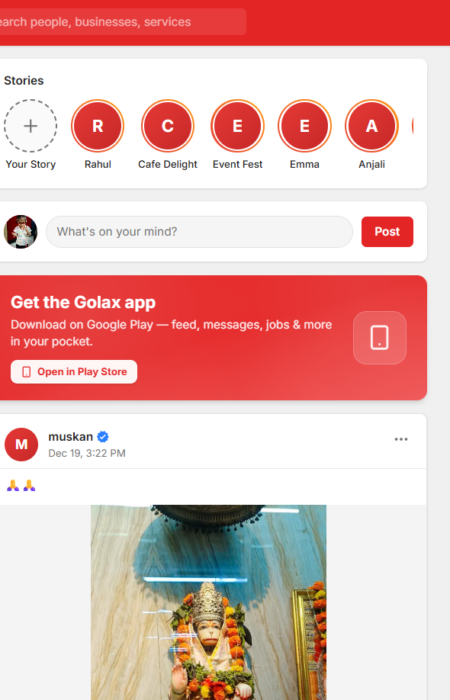
While Facebook shows users content from friends, creators, and distant communities, Golax’s feed is built around local usefulness. Users can discover nearby shops, services, offers, hiring updates, events, and neighborhood recommendations.
In other words, it transforms social media from entertainment into utility-driven local discovery.
That shift may sound subtle, but in the Indian market it can be deeply powerful.
India’s commerce still runs heavily on trust, familiarity, and word-of-mouth. People often choose a service provider because someone nearby recommended them. Families rely on neighborhood referrals for tutors, clinics, coaching centers, salons, repair technicians, and local vendors.
Golax digitizes this exact behavioral pattern and turns it into a scalable platform.
The Business Discovery Engine: A Big Win for Local Sellers
One of the most promising aspects of the Golax ecosystem is its business discovery engine.
For small businesses and local service providers, discoverability is often the biggest challenge. Many highly skilled local professionals lose customers simply because they lack digital presence. Golax offers them a direct path to visibility without forcing them into expensive ad systems or lead-based commissions.
This makes the model especially attractive for:
- electricians
- plumbers
- tutors
- laptop repair specialists
- beauty professionals
- delivery partners
- local agencies
- freelance service providers
who still depend largely on offline referrals.
For these businesses, Golax can become both a digital storefront and a trust-building engine.
Hyperlocal Jobs: Keeping Talent Within the City
The jobs layer adds another major dimension to the platform.
Golax’s hyperlocal jobs feature has the potential to become one of its strongest long-term growth engines. By allowing local companies and businesses to post city-level opportunities, the platform can help reduce information gaps in employment markets, especially in tier-2 cities where opportunities exist but remain scattered and informal.
This could create meaningful economic impact.
- For local businesses, hiring becomes easier
- For youth, nearby opportunities become visible
- For cities, talent retention improves
- For startups, recruitment costs may decrease
In regions like Bihar, Jharkhand, Uttar Pradesh, and other fast-growing state economies, this can be a major value proposition.
Community Recommendations: Digital Word-of-Mouth at Scale
Another powerful pillar of the Golax model is community-led recommendations.
India remains one of the strongest word-of-mouth markets in the world. Consumer decisions are heavily influenced by trusted local circles. Golax leverages follows, likes, comments, profile interactions, and neighborhood engagement to create a digital recommendation engine rooted in local trust.
Imagine these everyday scenarios:
- a user discovering the best nearby doctor because a known resident recommended them
- a student finding a top coaching institute through local reviews
- a family identifying a reliable electrician because multiple people in the area endorsed the service
- a local event gaining traction through community sharing
These are not abstract use cases.
They reflect real Indian consumer behavior.
Golax’s community architecture gives this behavior digital scale.
Beyond Commerce: The Public Utility Opportunity
Perhaps the most ambitious aspect of the startup is its public utility and governance layer.
The roadmap suggests future expansion into:
- farmer support ecosystems
- local administration updates
- student communities
- youth networking
- awareness around government schemes
- education and coaching discovery
If executed effectively, this could position Golax not just as a business platform, but as a local digital infrastructure layer for emerging Bharat.
This is especially relevant in semi-urban and rural India, where awareness gaps around schemes, opportunities, and local services remain significant.
Why Patna Makes This Story Bigger
The fact that Golax is being built out of Patna, Bihar makes the story even more significant.
It reflects a larger shift in India’s startup landscape: the next generation of impactful startups is increasingly emerging from regional cities where the problems are sharper, the market gaps are clearer, and founders understand local behavior far more intimately than metro-first companies.
Patna is not just the base of this company.
It is symbolic of a broader movement.
India’s next internet wave is likely to be built around local utility, trust, and community—not just global social engagement.
And Golax is aligning itself directly with that future.
The Road Ahead: Opportunity vs Execution
The startup’s larger opportunity lies in becoming a local digital infrastructure layer for Bharat—a hybrid of:
- social networking
- service discovery
- jobs
- local commerce
- community trust
- public awareness
If the company successfully builds strong network effects city by city, it could evolve into a serious desi alternative to fragmented Facebook groups, outdated local directories, and informal WhatsApp communities.
Of course, the road ahead is not without challenges.
Like any hyperlocal platform, Golax will need to solve for:
- user acquisition
- business onboarding
- verification systems
- content quality
- spam prevention
- city-wise scaling
- sustainable network effects
Execution will determine whether the model remains a promising idea or becomes a category-defining platform.
Final Verdict: A New Operating Layer for Bharat’s Local Internet
At a time when India is rapidly digitizing its small businesses, neighborhood services, and local communities, the need for a trusted hyperlocal ecosystem is stronger than ever.
Golax is not just building an app.
It is attempting to digitize India’s neighborhood economy.
That is what makes it exciting.
If the company can scale its Patna-first model into other cities across Bihar, Jharkhand, Uttar Pradesh, and eastern India, it may well emerge as one of the most interesting hyperlocal startups in the country.
In many ways, Golax represents the future of Bharat’s local internet:
- utility-first
- trust-led
- community-powered
- deeply rooted in geography
This is not just another startup story.
It is a glimpse into how India’s local markets may evolve over the next decade.



[…] Justdial and Facebook’s Desi Avatar: How Golax Is Transforming India’s Local Market into a Digi… […]