




The Foldable Future: Apple’s Strategic Leap with the iPhone Ultra
The smartphone industry stands at the precipice of its most significant evolution since the introduction of the original iPhone in 2007. For years, the tech world has buzzed with speculation regarding Apple’s entry into the foldable market, a sector currently dominated by Samsung’s Galaxy Z series and Huawei’s Mate X line. Recent intelligence and supply chain leaks suggest that Apple is finally preparing to break its silence. Expected to arrive in late 2026, the device—rumored to be named the iPhone Ultra—represents more than just a new product category; it is Apple’s definitive answer to the structural and longevity challenges that have plagued early foldable hardware. By merging the portability of a smartphone with the expansive canvas of an iPad, Apple aims to redefine the premium mobile experience through a combination of proprietary hinge technology, record-breaking battery life, and a unique “passport” form factor.
A New Philosophy in Foldable Design
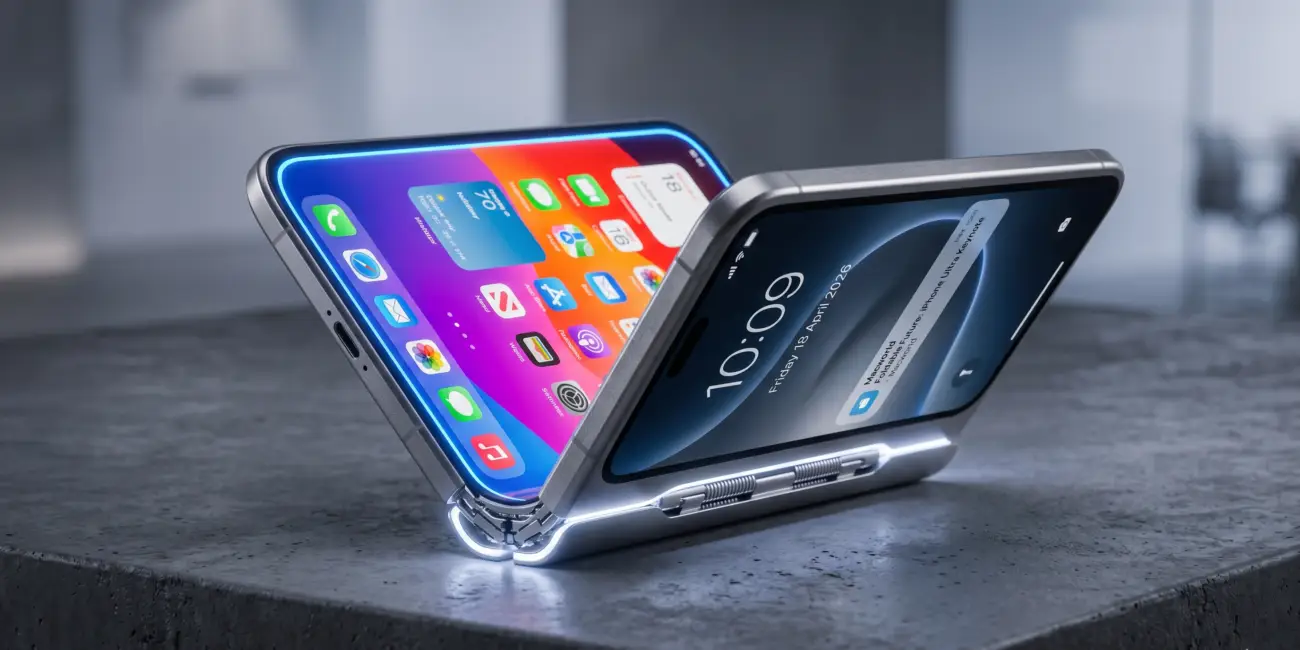
While competitors have leaned into the “clamshell” flip design for mass-market appeal, Apple is reportedly pursuing a more ambitious “book-style” architecture. This design choice aligns with the company’s vision of the iPhone Ultra as a hybrid productivity tool. Unlike the narrow, tall aspect ratios found on the Samsung Galaxy Z Fold series, Apple appears to be favoring a wider “passport” form factor. This broader stance offers a more natural reading and typing experience when the device is closed, moving away from the “remote control” feel of current foldables. When unfolded, the device transforms into a massive 7.8-inch internal display, effectively placing the power of an iPad Mini in the user’s pocket.
Engineering this transition requires overcoming the “crease,” a physical indentation at the fold point that has become a hallmark of current foldable screens. To solve this, Apple is reportedly developing a sophisticated display assembly using variable-thickness glass. This glass is engineered to be thinner and more flexible at the hinge point while maintaining structural rigidity across the rest of the panel. By utilizing an optically clear adhesive to reduce stress on the folding area and incorporating metal plates to distribute bending tension, Apple intends to deliver a display that remains perfectly flat even after years of intensive use. This obsession with a “crease-free” experience is widely cited as the primary reason for Apple’s delayed entry into the market, as the company refused to compromise on the seamless aesthetic that defines its brand.
Hardware Innovation and the Hinge Mechanism
The heart of the iPhone Ultra lies in its hinge, a component that has historically been the “Achilles’ heel” of foldable devices. Reports indicate that Apple is exploring the use of titanium alloys and LiquidMetal to create a mechanism that is both incredibly durable and remarkably thin. This advanced materials science allows the device to reach an unprecedented level of sleekness, with rumors suggesting a thickness of just 4.5mm when unfolded. To achieve this, Apple has had to rethink the internal layout of the device entirely. One of the most significant shifts is the reported move from Face ID to Touch ID. Because the sensors required for Face ID are difficult to embed in such a thin, folding frame without creating a large notch or cutout, Apple is expected to integrate a Touch ID sensor into the power button, a design language already successfully implemented in the iPad Air and iPad mini.
Internally, the iPhone Ultra will be a powerhouse, likely driven by the A20 or A20 Pro silicon. This chip will not only need to manage standard smartphone tasks but also handle the complex windowing and multitasking capabilities required for a 7.8-inch display. Connectivity will be handled by Apple’s next-generation proprietary modems, ensuring that the device remains at the cutting edge of 5G and Wi-Fi 7 performance. The camera system, while potentially lacking a dedicated telephoto lens to maintain the device’s slim profile, will feature a dual 48-megapixel array. This setup focuses on delivering exceptional wide and ultrawide performance, catering to the creative professional who values color accuracy and high-resolution detail over extreme zoom capabilities.
Redefining Battery Life and Efficiency
Perhaps the most critical battleground for the iPhone Ultra is energy management. Foldable devices are notorious for their high power consumption due to the massive internal screens they must illuminate. In response, Apple is reportedly equipping the iPhone Ultra with a battery capacity ranging between 5,000mAh and 5,500mAh. This would represent the largest battery ever integrated into an iPhone, a necessary move to ensure that the device can survive a full day of “pro-level” usage. This focus on battery longevity is a direct challenge to Huawei and Samsung, who have long used high-capacity batteries as a key selling point for their foldable flagships.
The efficiency of the A20 chip, built on a refined 2-nanometer process, will play a vital role in this ecosystem. By optimizing background processes and leveraging more efficient display drivers, Apple aims to provide a device that doesn’t just have a large battery, but uses it more intelligently than any other foldable on the market. This synergy between hardware and software—a hallmark of Apple’s vertical integration—will be the “secret sauce” that determines if the iPhone Ultra can truly replace both a phone and a tablet for the modern power user.
Market Positioning and the Ultra-Premium Price Point
The introduction of the iPhone Ultra will represent a new ceiling for Apple’s pricing strategy. Positioned well above the Pro Max models, the Ultra is expected to enter the market with a starting price of approximately $1,999, with higher storage tiers potentially reaching as high as $2,399. This pricing reflects the immense research and development costs associated with the hinge and display technologies, as well as the high cost of the specialized materials used in its construction. Apple is not targeting the mass market with the first generation of this device; rather, it is aiming for early adopters, tech enthusiasts, and enterprise professionals who require the ultimate in mobile productivity.
The launch, currently rumored for September 2026, will likely be the centerpiece of that year’s keynote. However, analysts warn that supply may be extremely limited during the initial rollout. The complexity of manufacturing a foldable screen that meets Apple’s stringent quality standards means that yield rates may be lower than those of standard iPhones. This scarcity, combined with the “Ultra” branding, will likely create a halo effect for the rest of the iPhone 18 lineup, further cementing Apple’s status as the leader in luxury consumer electronics.
Conclusion: A Calculated Evolution
Apple’s journey toward a foldable iPhone has been a marathon, not a sprint. While critics have often pointed to the company’s “lateness” to the foldable party, the leaked specifications of the iPhone Ultra suggest that Apple has used this time to observe the failures of others and engineer solutions that are genuinely transformative. By focusing on a crease-free display, a rugged yet thin titanium hinge, and a massive battery, Apple is attempting to solve the fundamental compromises of the foldable category. If the rumors hold true, the 2026 launch will not just be about a phone that folds; it will be about the birth of a new era in mobile computing, where the boundaries between the phone, the tablet, and the workstation finally disappear. The iPhone Ultra is poised to be the most expensive, most powerful, and most significant leap in the history of the iPhone, marking the moment when the “future of the smartphone” finally becomes a reality.

Other Articles

The Evolving Landscape of Xbox Game Pass