




The Great Xbox Pivot: Asha Sharma’s Plan to Save Game Pass via Advertising and Infrastructure
The landscape of interactive entertainment is currently weathering a profound transformation as Microsoft Gaming, under the relatively new leadership of CEO Asha Sharma, begins a radical restructuring of the Xbox brand. After years of aggressive acquisitions and a “play anywhere” marketing strategy that struggled to convert casual observers into paying subscribers, the internal strategy at Microsoft has shifted. Recent leaks and expert analysis suggest that the future of Xbox will be defined by two distinct but intertwined pillars: the aggressive integration of an advertising-supported ecosystem and a massive, foundational overhaul of the platform’s aging technical infrastructure. This shift marks the definitive end of the “console war” era, replaced by a “platform-as-a-service” model that mirrors the evolution of streaming giants like Netflix and retail-tech hybrids like Instacart.
The economic reality facing Microsoft Gaming in early 2026 is stark. While Xbox Game Pass was once hailed as the “best deal in gaming,” the service has reached a saturation point. With the Ultimate tier priced at $30 per month, the platform has successfully captured the core enthusiast market but has struggled to penetrate the broader global audience of three billion gamers. Industry researchers, most notably Joost van Dreunen, have pointed out that subscription models in the console space excel at retention but are surprisingly poor drivers of growth. They change how current players spend money—often leading them to buy fewer individual titles—without necessarily bringing in new players who weren’t already part of the ecosystem. To break this stalemate, Sharma is looking toward a “better value equation” that involves a significant price drop facilitated by a force the gaming industry has long resisted: mandatory advertising.
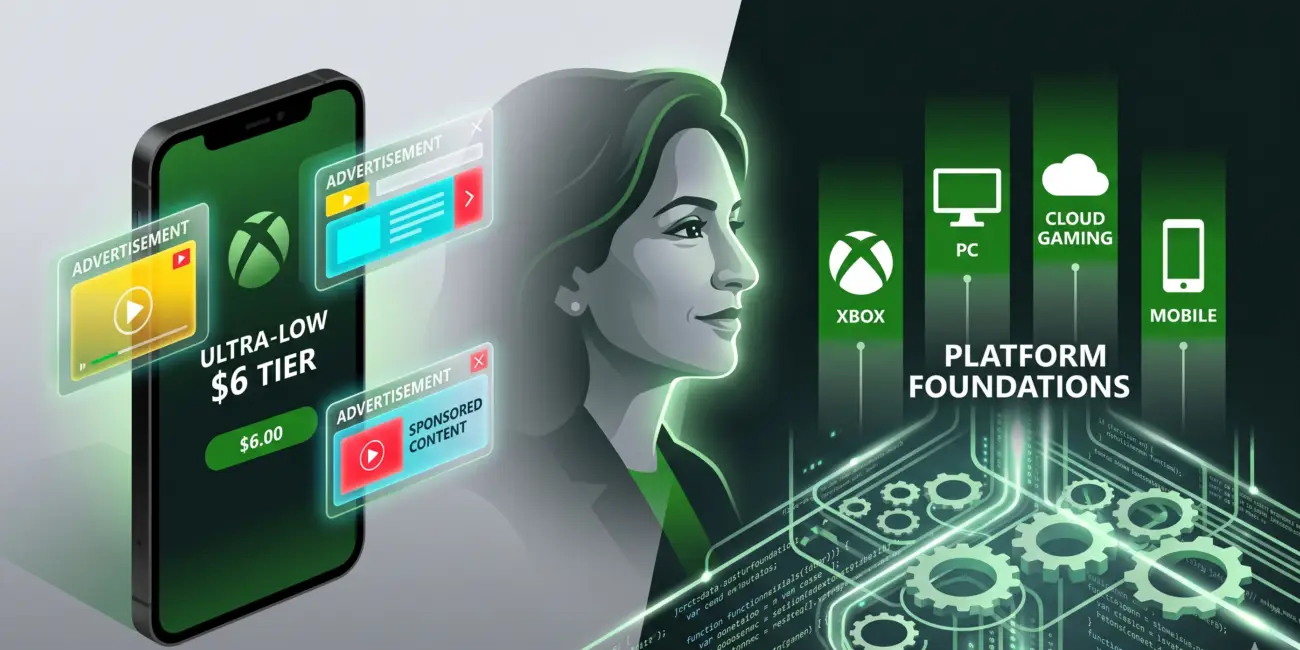
Central to this new vision is the rumored $6 Game Pass tier. This ultra-low-cost entry point is designed to dismantle the barrier to entry for the “non-paying” masses. By offering a subscription that is cheaper than a fast-food meal, Microsoft hopes to aggregate an audience size that makes the platform irresistible to advertisers. The logic follows a historical pattern seen in television, radio, and the internet, where content eventually becomes a vehicle for commercial messaging. While the gaming community has historically been hostile to ads, citing “cultural pride” and the desire for immersion, the sheer scale of the market in 2026 has turned gaming from a niche subculture into a dominant media market. In this environment, the inclusion of ads is no longer seen by leadership as an intrusion, but as a standard economic necessity for sustainability.
Asha Sharma’s appointment as CEO in February 2026 was the first major signal of this strategic pivot. Having previously served as the COO of Instacart, Sharma is not a traditional gaming executive; she is an architect of high-margin advertising platforms. During her tenure at Instacart, she helped transform the company from a simple grocery delivery service into an “audience platform” where advertising revenue eventually grew faster than the core delivery business. Experts believe she is now applying this identical blueprint to Xbox. Under her guidance, the goal is to move beyond direct monetization—selling games or high-priced subscriptions—and toward a full-stack model where the platform itself acts as a distribution and data-harvesting engine. This approach treats the player not just as a customer, but as an impression for advertisers, allowing Microsoft to subsidize the cost of high-budget titles through diverse revenue streams.
However, building a massive advertising and distribution engine requires a mechanical reliability that the current Xbox backend lacks. In a leaked internal memo, Sharma was remarkably candid about the “technical debt” currently hampering the organization. She noted that Xbox is operating across dozens of different surfaces and release models without a shared code repository or a common data foundation. This fragmentation is a direct byproduct of Microsoft’s rapid expansion; when the company acquired ZeniMax and Activision Blizzard, it inherited decades of proprietary technology, different server architectures, and siloed development cultures. Currently, the “speed and quality” of Xbox releases often depend on the “heroics” of individual developers rather than a streamlined, automated system. Sharma’s mandate for “deeper investment in platform foundations” is a move to unify these silos into a single, cohesive engine.
This infrastructure overhaul is particularly critical for the PC and mobile experience. Sharma has identified that discovery, relevance, and social features on the Xbox platform are currently not “first-class.” For a platform that wants to be everywhere, the friction of switching between a console, a PC, and a cloud-enabled handheld is still too high. By building a unified “foundation,” Microsoft intends to create a scenario where a developer can write code once and have it deploy seamlessly across every device. This is the “Helix” philosophy taken to its logical conclusion: an invisible backend that makes the hardware choice irrelevant. If the social features and game discovery algorithms are improved to match the standards of social media or modern streaming apps, Xbox becomes less of a “box” and more of a digital environment that follows the user.
The reaction from the broader industry has been a mix of skepticism and cautious intrigue. Former PlayStation executive Shawn Layden has been one of the most vocal critics, describing the prognosis for the current Game Pass model as “grim.” His assessment suggests that the high costs of maintaining a rotating library of blockbuster titles may never be fully covered by a traditional subscription fee alone, hence the desperate need for the ad-supported “pivot.” Even Netflix, a potential future partner for Xbox, has expressed interest in how Sharma will navigate these waters. Netflix co-CEO Greg Peters recently admitted to “kicking around ideas” for a subscription bundle with Xbox, though he noted that Microsoft is still very much in the process of “figuring out” how to make the Game Pass math work.
The cultural implications of this shift are equally significant. One of Sharma’s first major acts was to kill the “This is an Xbox” marketing campaign, which attempted to brand everything from smart TVs to sticks as an Xbox. To Sharma, this approach lacked the specific “feeling” of the brand. By moving away from vague marketing and focusing on the underlying value proposition—cheaper access through ads and better performance through unified tech—she is attempting to redefine what the brand stands for. The future she envisions is one where Xbox is a “media market” first and a console second. This means the brand might lose some of its traditional identity as a premium hardware manufacturer, but it gains the potential to become a ubiquitous utility in the daily lives of billions.
As we move further into 2026, the success of this strategy will depend on the delicate balance between value and intrusion. If the $6 tier feels like a “budget” experience riddled with poorly integrated commercials, it may alienate the very audience it seeks to attract. Conversely, if Sharma can leverage her experience to build an advertising ecosystem that feels native to the gaming experience—perhaps through rewarded video or non-intrusive in-game placements—Xbox could finally achieve the scale that has eluded it for two decades. The “deeper investment” in foundations is the gamble that Microsoft can turn a collection of disparate, acquired companies into a singular, high-speed machine capable of dominating the next era of digital media. For now, the “Asha Sharma era” is defined by a move toward transparency, efficiency, and the undeniable, creeping arrival of the commercial break.