



Kentucky Derby Controversy: $500 Fine Sparks Major Debate Over Race-Day Rules and Fairness
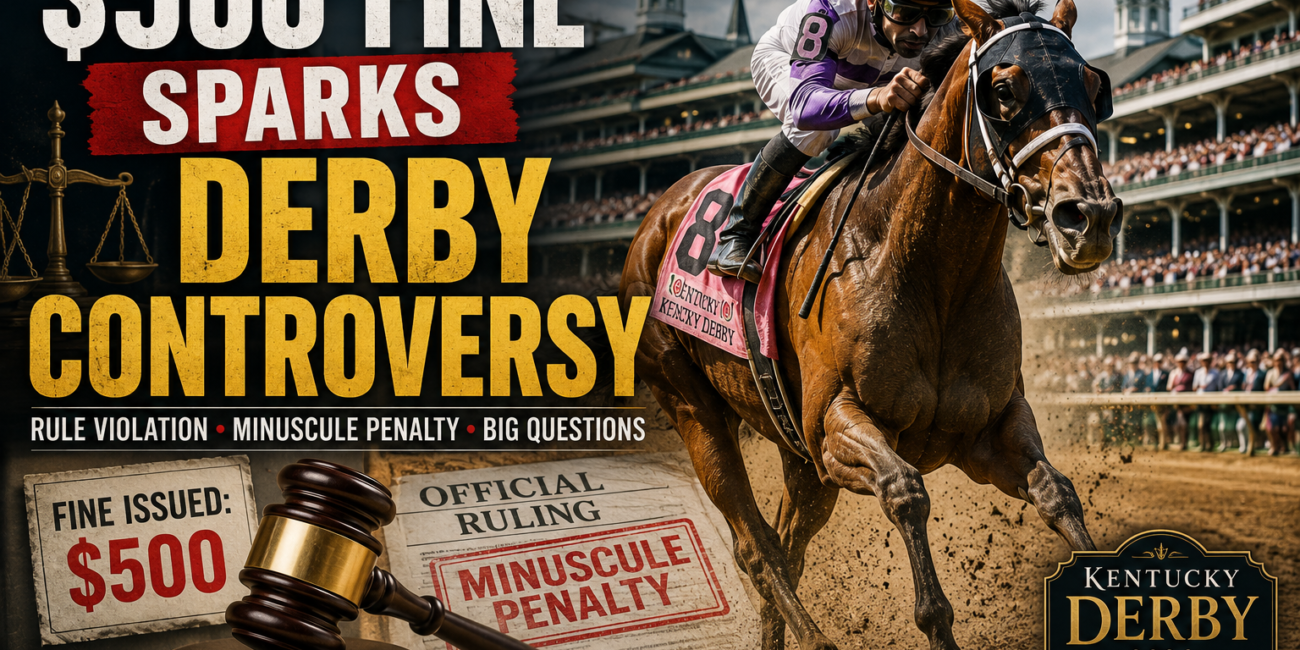
The 2026 Kentucky Derby, one of the most prestigious and closely watched horse racing events in the world, has become the center of controversy following a decision that many critics are calling too lenient. What should have been remembered purely as a thrilling race has instead sparked widespread debate after a jockey involved in a race-day violation was issued a fine of just $500 — a penalty many observers consider insignificant given the scale and importance of the event.
The incident has raised serious questions about fairness, consistency in rule enforcement, and whether high-profile races are subject to different standards than smaller competitions. As reactions continue to pour in from fans, analysts, and racing experts, the controversy is quickly becoming one of the most talked-about moments in recent Kentucky Derby history.
A Dramatic Race Overshadowed by Controversy
The Kentucky Derby is known for its intensity, prestige, and the immense stakes involved, not just in terms of prize money but also reputation. The 2026 edition lived up to expectations on the track, delivering a dramatic finish that kept spectators on edge until the final moments. However, the excitement of the race was soon overshadowed by post-race developments involving a rule violation during the competition.
During the race, jockey Irad Ortiz Jr. was found to have committed an infraction. While the exact nature of the violation drew attention, what shocked many observers was not just the incident itself but the penalty that followed. Officials decided to issue a fine of only $500, without any further disciplinary action such as suspension or disqualification.
For an event of this magnitude, where millions of dollars and global recognition are at stake, the small fine has been widely criticized as insufficient and ineffective.
The Decision That Sparked Debate
In professional horse racing, rules are designed to ensure fairness, safety, and integrity. Violations during a race are typically reviewed carefully, and in some cases, penalties can include disqualification, position changes, or significant fines. However, in this case, the authorities chose not to alter the race results.
The horse ridden by Ortiz finished in second place, and despite the violation, the official standings remained unchanged. The winning horse retained its victory, and no positions were adjusted as a result of the incident.
This decision has become the focal point of the controversy. Critics argue that if a violation is serious enough to warrant a penalty, then it should also have consequences that impact the race outcome. The absence of such consequences has led many to question whether the rules are being applied consistently.
Why the Fine Is Being Called “Minuscule”
The $500 fine has been described by many as “minuscule,” especially when compared to the scale of the Kentucky Derby. The event attracts global attention, generates massive betting activity, and involves significant financial stakes for owners, trainers, and jockeys.
In that context, a $500 penalty appears negligible. For professional jockeys competing at the highest level, such an amount is unlikely to serve as a deterrent. This has led to criticism that the punishment does not reflect the seriousness of the violation or the importance of maintaining strict standards in elite competitions.
Many analysts believe that penalties in high-profile races should be proportionate to the stakes involved. When the consequences are too small, they risk undermining confidence in the sport’s governance.
Concerns About Fairness and Integrity
One of the biggest concerns arising from this incident is the perception of fairness. Horse racing relies heavily on trust, both from participants and from fans. When decisions appear inconsistent or overly lenient, it can damage the credibility of the sport.
Some critics have questioned whether similar violations in lower-tier races would have resulted in stricter penalties. This has fueled speculation that major events like the Kentucky Derby might be treated differently due to their high visibility and commercial importance.
The lack of stronger action in this case has led to broader discussions about whether rules are being enforced equally across all levels of competition. For many observers, maintaining fairness is essential to preserving the integrity of horse racing.
Reactions from the Racing Community
The reaction to the decision has been swift and divided. While some within the racing community have defended the officials, arguing that the violation did not significantly affect the race outcome, others have strongly criticized the ruling.
Fans have expressed frustration on social media, with many questioning how such a small fine could be considered appropriate. Analysts and commentators have also weighed in, highlighting the potential long-term impact of such decisions on the sport’s reputation.
Some experts have pointed out that even minor infractions can have major consequences in a race as competitive as the Kentucky Derby. In such a closely contested environment, any advantage — intentional or not — can influence the final result.
The Bigger Issue in Modern Sports
This controversy is not just about a single race or a single penalty. It reflects a larger issue that extends across many sports: the challenge of enforcing rules consistently while maintaining public trust.
In recent years, there has been growing scrutiny of officiating decisions in major sporting events. Whether it is football, cricket, or horse racing, fans expect transparency and accountability. When decisions appear unclear or inconsistent, they often lead to widespread criticism.
The Kentucky Derby incident highlights the importance of clear guidelines and proportional penalties. It also underscores the need for governing bodies to communicate their decisions effectively, so that fans and participants understand the reasoning behind them.
What This Means for the Future
The fallout from this controversy could have lasting implications for horse racing. Governing bodies may face increased pressure to review their rules and ensure that penalties are aligned with the seriousness of violations.
There may also be calls for greater transparency in decision-making processes. Providing detailed explanations for rulings could help reduce confusion and rebuild trust among fans and stakeholders.
In addition, this incident could lead to discussions about introducing stricter penalties for race-day violations, especially in high-profile events. Ensuring that punishments serve as effective deterrents will be crucial in maintaining the integrity of the sport.
A Defining Moment for the Kentucky Derby
The Kentucky Derby has a long history of iconic moments, unforgettable races, and legendary champions. However, the 2026 edition may be remembered as much for its controversy as for its competition.
While the race itself delivered excitement and drama, the aftermath has shifted the focus toward governance and fairness. The $500 fine, though small in monetary terms, has had a significant impact on public perception.
As the debate continues, one thing is clear: the incident has sparked an important conversation about how rules are enforced in one of the world’s most prestigious sporting events. Whether this leads to meaningful changes remains to be seen, but the spotlight is now firmly on the future of fairness and accountability in horse racing.
In the end, the controversy serves as a reminder that in sports, decisions off the track can be just as important as the action on it.