


Why Anthropic’s Google Deal Could Make Nvidia Nervous
Introduction
A major shift may be unfolding in the artificial intelligence hardware race. A new long-term partnership between Anthropic and Google signals that some of the world’s most advanced AI companies may be moving away from Nvidia’s GPUs toward custom-built chips. Because Nvidia currently dominates AI computing infrastructure, this development has sparked concerns among analysts that the company’s long-term dominance could face serious competition.
The Anthropic–Google Agreement
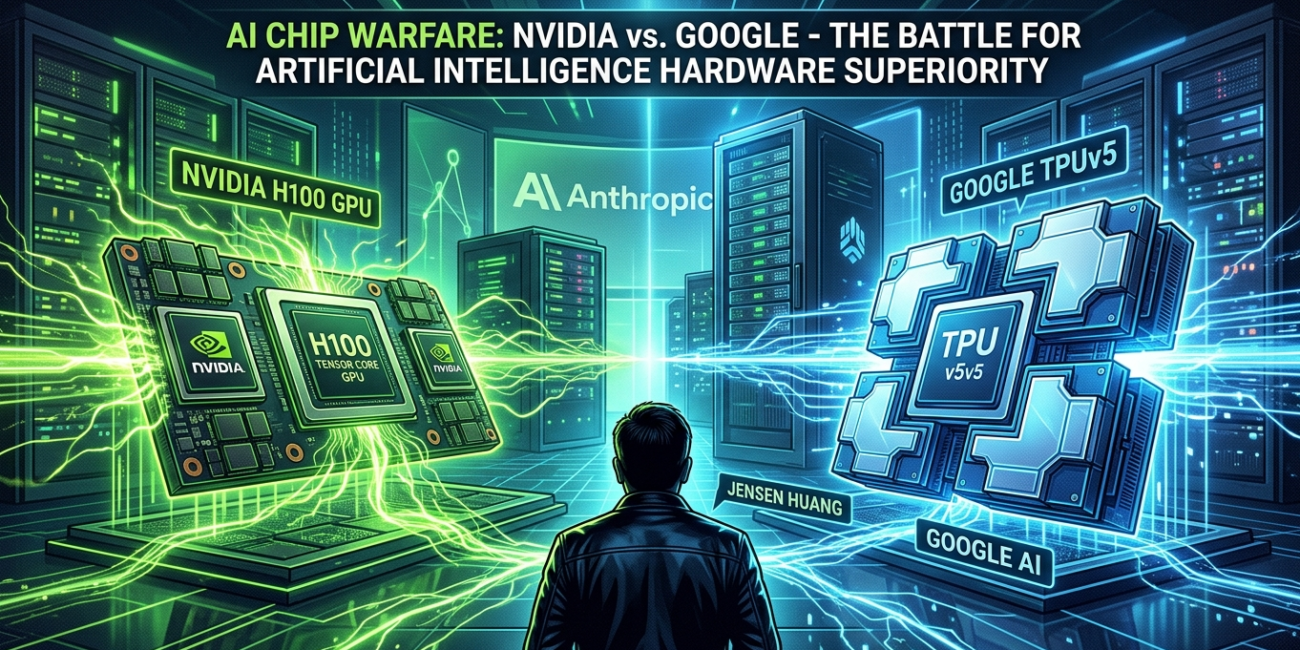
Anthropic has reportedly secured a massive compute deal with Google that will rely heavily on Google’s custom Tensor Processing Units (TPUs). The scale of this agreement is enormous, measured in gigawatts of computing power, and is expected to begin ramping significantly around 2027. The deal also involves Broadcom, which is helping Google design and manufacture these custom AI chips. This partnership indicates that Anthropic intends to train and run future AI models using Google’s infrastructure instead of relying primarily on Nvidia GPUs.
Why This Matters for Nvidia
Nvidia has built its leadership position by supplying GPUs that power most modern AI models. Companies like OpenAI, Meta, Microsoft, and Anthropic have historically depended on Nvidia hardware for both training and inference. If major AI labs begin shifting to alternative chips such as Google’s TPUs, Nvidia risks losing one of its biggest sources of demand. The Anthropic deal signals that large AI companies now have credible alternatives to Nvidia’s ecosystem.
The Rise of Custom AI Chips
The agreement also reflects a broader industry trend in which large technology companies are designing their own AI accelerators. Google has TPUs, Amazon is developing Trainium, Microsoft is working on Maia, and Meta is building its own AI chips. These companies want more control over costs, performance, and supply chains. Custom silicon allows them to optimize hardware specifically for their models and avoid relying on a single vendor. As more companies follow this strategy, Nvidia’s market share could gradually face pressure.
The Importance of Inference Computing
Another reason this deal is significant is the growing importance of inference. Training large models requires massive computing resources, but running those models at scale over time often requires even more compute. Custom chips like TPUs are designed to be power-efficient and cost-effective for inference workloads. If Anthropic deploys future Claude models on Google TPUs, Nvidia could lose long-term recurring demand rather than just one-time training purchases.
Nvidia’s Current Advantage
Despite these concerns, Nvidia still holds a strong lead. Its CUDA software ecosystem remains deeply embedded in AI development workflows. Nvidia GPUs also continue to deliver top-tier performance and flexibility. Most AI companies still rely heavily on Nvidia hardware today, and transitioning away from that ecosystem is complex and time-consuming. The Anthropic deal therefore represents a warning sign rather than an immediate threat.
The Competitive Landscape Ahead
The AI infrastructure market is evolving quickly as hyperscalers invest billions into custom silicon. If more AI labs follow Anthropic’s path, the market could shift from a GPU-dominated landscape to one where multiple chip architectures compete. This would reduce Nvidia’s pricing power and reshape how AI infrastructure is built. The outcome will likely depend on performance, cost efficiency, developer support, and long-term scalability.
Conclusion
Anthropic’s partnership with Google marks one of the largest AI compute agreements to date and highlights the growing push toward custom AI chips. While Nvidia remains the dominant player today, the deal underscores that major technology companies are actively working to reduce dependence on its GPUs. If this trend accelerates, Nvidia’s leadership could face meaningful competition in the years ahead.
Source: Times of India — “Why Anthropic’s Google deal should make Nvidia and its CEO Jensen Huang nervous”