




World Quantum Day: Celebrating the Science That Shapes the Future
Introduction
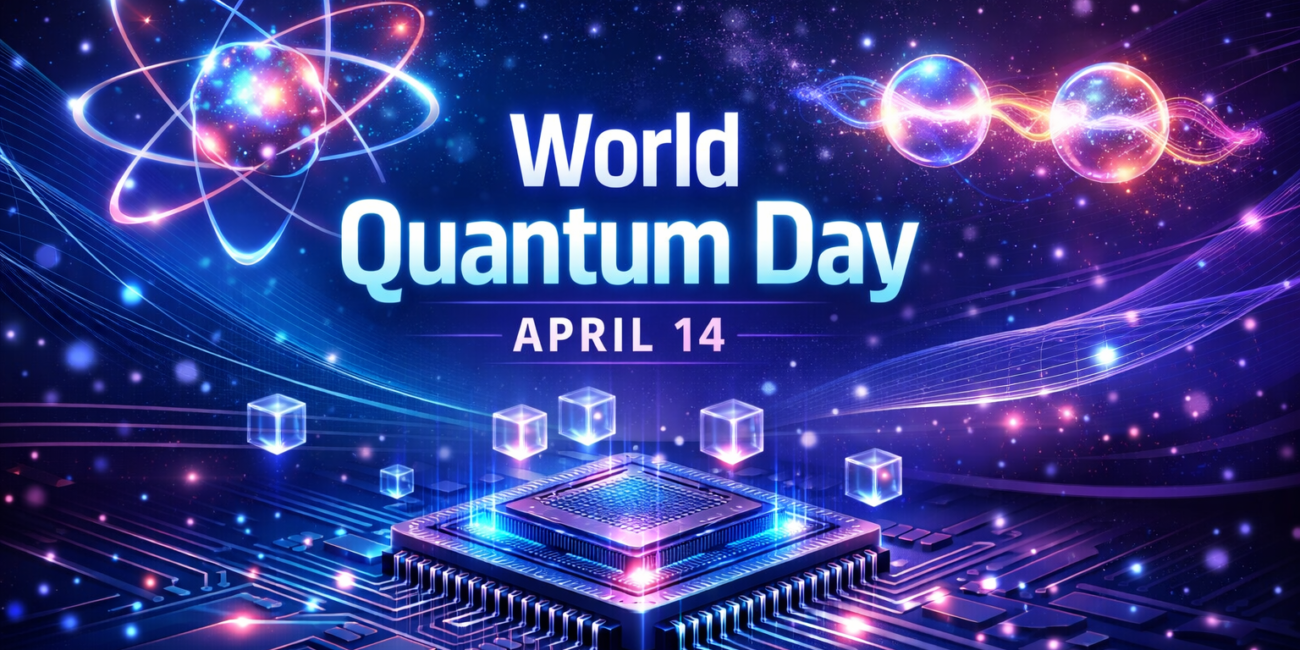
World Quantum Day is an international celebration dedicated to promoting public awareness and understanding of quantum science and quantum technology. Observed every year on April 14, the day highlights the importance of quantum mechanics and its growing influence on modern technology, research, and innovation. The date April 14 symbolizes the first three digits of Planck’s constant, 4.14 × 10⁻¹⁵ eV·s, which plays a fundamental role in quantum physics. World Quantum Day brings together scientists, educators, students, institutions, and the general public to explore the fascinating and often counterintuitive world of quantum phenomena. Through educational activities, public lectures, workshops, and outreach programs, the day aims to bridge the gap between complex scientific ideas and everyday understanding.
Quantum science has transformed our understanding of nature at the smallest scales. From the behavior of atoms and photons to advanced technologies such as quantum computing and quantum communication, quantum mechanics forms the foundation of many scientific breakthroughs. World Quantum Day serves as an opportunity to celebrate these advancements while encouraging the next generation of scientists and innovators.
Wikipedia reference: https://en.wikipedia.org/wiki/World_Quantum_Day
Origin and Establishment of World Quantum Day
World Quantum Day was first celebrated in 2021 as a grassroots initiative led by an international group of scientists. The idea emerged from the growing importance of quantum science in both academic research and technological development. Researchers wanted to create a global event that would increase public awareness of quantum physics and inspire students to pursue careers in science and technology. The selection of April 14 was deliberate, referencing Planck’s constant, a central value in quantum mechanics discovered by Max Planck.
The initiative quickly gained support from universities, research institutions, scientific societies, and educational organizations across the world. Events began to be organized in multiple countries, including lectures, science exhibitions, online seminars, and interactive demonstrations. The success of the first celebration encouraged organizers to make World Quantum Day an annual event. Over time, the day has expanded into a global celebration involving hundreds of institutions and thousands of participants.
Wikipedia reference: https://en.wikipedia.org/wiki/Max_Planck
Wikipedia reference: https://en.wikipedia.org/wiki/Planck_constant
What Is Quantum Mechanics
Quantum mechanics is a fundamental theory in physics that describes the behavior of matter and energy at atomic and subatomic scales. Unlike classical physics, which explains everyday phenomena, quantum mechanics deals with probabilities, wave-particle duality, uncertainty, and superposition. These concepts challenge traditional intuition but accurately describe how nature behaves at extremely small scales.
One of the most surprising aspects of quantum mechanics is that particles can exist in multiple states simultaneously. This phenomenon is known as superposition. Another key concept is quantum entanglement, where two particles become connected so that the state of one instantly influences the state of another, even across large distances. These principles form the basis of modern quantum technologies, including quantum computers and quantum communication systems.
Wikipedia reference: https://en.wikipedia.org/wiki/Quantum_mechanics
Wikipedia reference: https://en.wikipedia.org/wiki/Quantum_superposition
Wikipedia reference: https://en.wikipedia.org/wiki/Quantum_entanglement
Historical Development of Quantum Theory
The development of quantum theory began in the early twentieth century when scientists encountered experimental results that classical physics could not explain. In 1900, Max Planck proposed that energy is quantized, meaning it exists in discrete packets called quanta. This idea solved the problem of blackbody radiation and marked the birth of quantum theory. Later, Albert Einstein extended the concept by explaining the photoelectric effect, demonstrating that light behaves as particles known as photons.
Further advancements came from scientists such as Niels Bohr, Werner Heisenberg, Erwin Schrödinger, and Paul Dirac. Bohr introduced a model of the atom where electrons occupy discrete energy levels. Heisenberg developed the uncertainty principle, which states that it is impossible to precisely measure both position and momentum simultaneously. Schrödinger formulated wave mechanics, providing mathematical equations that describe quantum systems. These contributions collectively shaped modern quantum mechanics.
Wikipedia reference: https://en.wikipedia.org/wiki/Photoelectric_effect
Wikipedia reference: https://en.wikipedia.org/wiki/Niels_Bohr
Wikipedia reference: https://en.wikipedia.org/wiki/Uncertainty_principle
Wikipedia reference: https://en.wikipedia.org/wiki/Schr%C3%B6dinger_equation
Importance of Quantum Science in Modern Technology
Quantum science is not limited to theoretical physics. It has practical applications that influence everyday technology. Many modern devices rely on quantum principles, including semiconductors, lasers, MRI machines, and GPS systems. Transistors, which form the foundation of computer chips, operate using quantum mechanical effects. Without quantum physics, modern electronics would not exist.
Lasers, used in telecommunications, medical procedures, and barcode scanners, depend on stimulated emission, a quantum phenomenon. Magnetic resonance imaging, widely used in hospitals, relies on nuclear magnetic resonance, another quantum effect. Even precise timekeeping in atomic clocks depends on quantum transitions within atoms. These applications highlight how quantum science has shaped modern society.
Wikipedia reference: https://en.wikipedia.org/wiki/Semiconductor
Wikipedia reference: https://en.wikipedia.org/wiki/Laser
Wikipedia reference: https://en.wikipedia.org/wiki/Magnetic_resonance_imaging
Wikipedia reference: https://en.wikipedia.org/wiki/Atomic_clock
Quantum Computing and Future Possibilities
Quantum computing is one of the most exciting developments celebrated on World Quantum Day. Unlike classical computers that use bits, quantum computers use quantum bits or qubits. These qubits can exist in multiple states simultaneously, allowing quantum computers to perform complex calculations much faster than classical computers for certain problems. Quantum computing has the potential to revolutionize fields such as cryptography, materials science, artificial intelligence, and drug discovery.
Researchers around the world are working to build stable and scalable quantum computers. Companies and governments are investing heavily in quantum research. Although quantum computers are still in the early stages, they are expected to solve problems that are currently impossible for classical systems. World Quantum Day highlights these advancements and encourages collaboration between researchers and industries.
Wikipedia reference: https://en.wikipedia.org/wiki/Quantum_computing
Wikipedia reference: https://en.wikipedia.org/wiki/Qubit
Quantum Communication and Security
Quantum communication is another major area of development in quantum science. It uses principles such as entanglement and quantum key distribution to create highly secure communication systems. Unlike classical encryption, quantum encryption can detect eavesdropping attempts, making communication more secure. This technology is expected to transform cybersecurity and protect sensitive information.
Quantum networks are being developed to connect quantum computers and enable secure data transfer. Several countries have already launched quantum communication satellites to test long-distance quantum encryption. These developments demonstrate how quantum science is moving from laboratories to real-world applications.
Wikipedia reference: https://en.wikipedia.org/wiki/Quantum_cryptography
Wikipedia reference: https://en.wikipedia.org/wiki/Quantum_key_distribution
Global Celebrations and Activities
World Quantum Day is celebrated worldwide through educational and outreach events. Universities organize lectures explaining quantum mechanics in simple terms. Schools conduct science demonstrations to spark curiosity among students. Online webinars and panel discussions bring together experts to discuss the future of quantum technology. Museums and science centers host exhibitions showcasing quantum experiments.
The day also promotes collaboration between scientists and the public. Many organizations release educational videos, articles, and interactive simulations. These activities help people understand how quantum science influences modern life. The goal is not only to celebrate scientific achievements but also to make quantum physics accessible to everyone.
Wikipedia reference: https://en.wikipedia.org/wiki/Science_outreach
Role of Education in Promoting Quantum Awareness
Education plays a crucial role in the success of World Quantum Day. Introducing quantum concepts at school and university levels helps students develop interest in physics and technology. Many institutions use World Quantum Day as an opportunity to conduct workshops and interactive learning sessions. These initiatives aim to simplify complex ideas and encourage curiosity.
Educational programs often include demonstrations of wave-particle duality, quantum tunneling, and interference. Teachers explain how quantum physics influences everyday devices. By connecting theory with real-life examples, students gain a deeper understanding of the subject. This approach helps build a scientifically informed society.
Wikipedia reference: https://en.wikipedia.org/wiki/Quantum_tunnelling
Wikipedia reference: https://en.wikipedia.org/wiki/Wave%E2%80%93particle_duality
Quantum Science and Industry Collaboration
Industry collaboration is essential for the growth of quantum technologies. Technology companies, research laboratories, and universities work together to develop quantum hardware and software. Investments in quantum startups have increased significantly in recent years. Governments have also launched national quantum initiatives to support research and development.
World Quantum Day encourages partnerships between academia and industry. These collaborations accelerate innovation and help translate theoretical research into practical applications. The development of quantum sensors, quantum networks, and quantum processors depends on such cooperative efforts.
Wikipedia reference: https://en.wikipedia.org/wiki/Quantum_technology
Why World Quantum Day Matters
World Quantum Day matters because quantum science is shaping the future. From secure communication to powerful computing systems, quantum technologies are expected to transform many industries. Raising awareness helps society understand these changes and prepare for technological advancements. It also encourages students to pursue careers in science, engineering, and research.
The celebration promotes international cooperation. Scientists from different countries share knowledge and collaborate on projects. This global effort accelerates scientific progress and benefits humanity. World Quantum Day reminds us that fundamental research can lead to revolutionary technologies.
Wikipedia reference: https://en.wikipedia.org/wiki/Quantum_information_science
Conclusion
World Quantum Day is more than a scientific celebration. It is a global initiative to promote understanding of quantum mechanics and its impact on modern life. Observed every year on April 14, the day highlights the importance of quantum science in technology, research, and education. From the early discoveries of quantum theory to the development of quantum computers, the field continues to evolve rapidly.
As quantum technologies advance, their influence on society will grow. World Quantum Day encourages curiosity, learning, and collaboration. It inspires students, researchers, and innovators to explore the quantum world and contribute to future discoveries. By celebrating quantum science, we acknowledge the power of fundamental research to transform our understanding of nature and shape the technologies of tomorrow.
Wikipedia reference: https://en.wikipedia.org/wiki/Quantum_physics

Other Articles